$ 64,000 has been allocated to move the 9-foot statue of Abraham Lincoln from Concert Grove in Prospect Park to near its original location at the northern end of Grand Army Plaza, according to the New York Post. For the last 50 years, the statue has faced a chain-link fence near Wollman Rink. Additional funds are being sought.(Photo: Paul Martinka)
President Lincoln is holding the Emancipation Proclamation and is pointing to the words "shall be forever free." The statue was designed by Henry Kirk Brown (1814–1886) and was dedicated on October 21, 1869. It remained at that location until May, 1895.
According to Richard Kessler, editor of Brooklyn Mirador, the elliptical Plaza was dedicated in 1867 with its axis pointed at the Manhattan mansion of William Backhouse Astor, the heir to the John Jacob Astor fortune. The centerpiece was a simple fountain named the "Fountain of the Golden Spray." In 1869, the Lincoln statue was dedicated at the north end of the Plaza's axis, facing north towards the unseen mansion. Olmsted, Vaux and Stranahan (the Brooklyn Parks Commissioner) were strong Lincoln supporters. Astor was not.
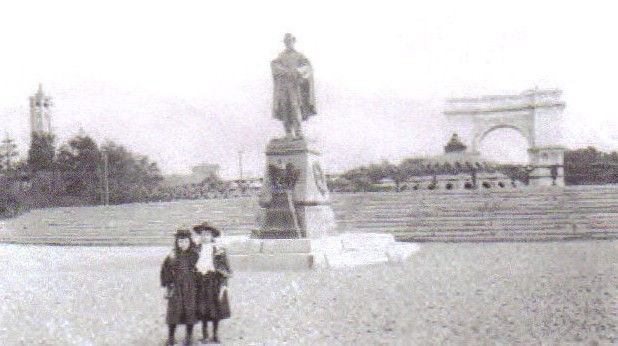
This early 1890s photo shows the Lincoln statue in its original location at the northern end of Prospect Park Plaza (now Grand Army Plaza). Note the Plaza's alignment of the unadorned Arch, the Calvert Vaux Fountain and the Lincoln statue. (Photo: William Lee Younger)
In 1895 (three years after Duncan's Arch framed the fountain, statue, and invisible corridor to the mansion) Olmsted retired, the Lincoln statue was picked up, turned around and abandoned in the Prospect Concert Grove. In November, Vaux was found drowned in Gravesend Bay. Six months later, the Supreme Court ruled that racial segregation was Constitutional.
In 1965, two years after his assassination, the JFK bust was unveiled in the spot where Lincoln stood.
Henry Kirk Brown has a number important works in our park system including two in Union Square Park - one of President Lincoln (1868) in the north end, and one in the south, the equestrian statue of George Washington, the oldest sculpture (1856) in possession of the New York City Parks Department, and reportedly the first ever purchased by the agency. – Geoffrey Croft
Brooklyn
After more than a century in exile, Abraham Lincoln is finally coming home, according to the New York Post.
Plans are in the works to move a larger-than-life bronze statue of "the Great Emancipator" that is tucked away in Prospect Park back to its original, prominent location at nearby Grand Army Plaza.
The 10-foot-tall statue, the first in the Union to honor the 16th president, was dedicated in October 1869, just four years after Lincoln's assassination.
The sculpture, which depicts the president draped in a cape and reading from a book, originally stood in what used to be known simply as "the Plaza," an oval parcel of land outside the park's entrance on Eastern Parkway and Flatbush Avenue.
In 1896, it was moved out of the shadow of the eight-story tall Soldiers and Sailors Memorial Arch, Brooklyn's tribute to the Union troops who died in the Civil War, to the Concert Grove in the park.
In 1960, the Wollman ice-skating rink was built nearby and a chain-link fence was constructed, detracting from the statue, which sits on a 20-foot stone pedestal.
"For the last 50 years, Abe has been looking at a chain-link fence," said Eugene Patron, of the Prospect Park Alliance, which is spearheading the effort to move the statue.
"It's still in the works, but the idea is to bring him back to Grand Army Plaza."
"The location he was in is not deserving of such a historical statue and prominent figure in our history," said Geoffrey Croft, president of NYC Park Advocates. "I am happy that he is going to a more appropriate location."

Henry Kirke Brown's statue of Abraham Lincoln in Prospect Park Plaza, Brooklyn ca. 1880. In 1866, the War Fund Committee of the City of Brooklyn organized a $1.00 subscription for a memorial to President Lincoln (1809 -1865) who was assassinated the previous year. (Sterograph from Robert Dennis Collection, New York Public Library)

Henry Kirke Brown was one of the first American sculptors to cast his own bronzes. He settled in the City of Brooklyn where he worked from his studio.
Read More:
New nabe for old AbeNew York Post - November 26, 2010 - By John Doyle