Showing posts with label Scott Stringer. Show all posts

Thursday, September 17, 2015

Comptroller To Brooklyn Bridge Park - Explore Using Bonds To Pay For Capital Improvements


Battle over Pier 6 luxe and affordable housing heats up

The Change Would Dramatically Alter The Park's Current Financial Model 

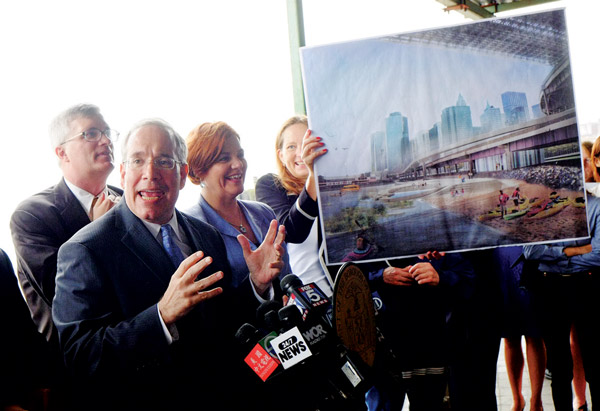
Rendering of the proposed 31 and 15-story towers at Pier 6 in Brooklyn Bridge Park. The Brooklyn Bridge Park Corporation is trying to justify the need to build this additional housing to help pay for the park.  The City's Comptroller's office has asked the corporation that oversees Brooklyn Bridge Park to explore the possibility of issuing bonds to finance future capital improvements instead.

Brooklyn


By Geoffrey Croft

The office of the City Comptroller Scott Stringer has asked the corporation that oversees Brooklyn Bridge Park to look into the feasibility of issuing bonds to finance future capital improvements. 

If adopted the move would remove Brooklyn Bridge Park Corporation's (BBPC) stated rational for developing the controversial Pier 6 project.  Opponents of the housing want the three acres developed into additional parkland. 

Yesterday First Deputy Comptroller Alaina Gilligo wrote to Regina Myer, president of the Brooklyn  Bridge Park Corporation (BBPC) and raised the issue of whether the corporation can access the municipal bond market for capital needs financing. 

"Since the public hearing on August 6, 2015, the Comptroller's office has received inquries from community stakeholders concerning whether BBPC may use tax-exempt or taxable bonds to finance Brooklyn Bridges Park's capital needs that would then be repaid by BBPC,"  the September 16th letter states. 

"Proponents of bond financing believe that the mechanism could fill the financial gap until the BBPC generates a surplus from concessions and Payment's in Lieu of Taxes ("PILOT'S"). 

The Comptroller's office found that BBPC may be able to issue tax-exempt bonds through an arrangement with a governmental agency to finance park capital improvements. 

"Because BBPC is a New York non-for-profit corporation, it may be able to issue tax-exempt bonds through a conduit governmental agency such as Build NYC Resources Corporation ("Build NYC")  — an arm of the New York City Economic Development Corporation ("EDC") — to finance park capital improvements. "  

The Comptroller's office wrote that the issue requires further analysis and advises BBPC to seek formal outside legal advise.  

Several elected officials who represent the area had asked the Comptroller's office to look into the feasibility of issuing the bonds to cover capital improvements. 

The move would dramatically change the park's current funding model which relies on money generated from real estate, including "PILOT'S",  concessions, and park fees. 

Issuing bonds to finance capital improvements would bring the park in line with the rest of the city park system which the BBPC is unlikely to support voluntarily.  

The corporation claims the funds from the proposed new housing are necessary to ensure the park's long term fiscal stability including maintaining the park's 13, 400 pilings under its piers.  
Open space advocates have long argued that the heavily utilized park should be funded by the government and not by funding schemes. 

The model of paying for the park with housing has been the subject of bitter debate since Mayor Bloomberg wrestled control of the park from the Governor and adopted a "self sustaining" model which has dramatically changed the development and operation of the park.   

Critics also point out that the current funding mechanism creates enormous disparities between the haves and the haves nots, including the well funded Brooklyn Bridge Park and the vast majority of other parks which rely on chronically underfunded municipal funding.  Mayor de Blasio has repeatedly said he was against these disparities. 

Until very recently the General Project Plan (GPP) allowed for building in the park only if a financial need could be demonstrated, which critics maintain they have no done.   

Initially just high-rise luxury housing, Mayor de Blasio added an affordable housing component which the administration had hoped would make the controversial plan easier to swallow. That has not happened.

In June the BBPC awarded the Pier 6 project to developer Robert Levine,  President & CEO of RAL Development Services weeks after Levine donated $10,000 to the mayor’s fundraising committee.  Levine is also the developer of controversial One Brooklyn Bridge Park.

All in the Family:  Prospect Park Alliance flack,  and former New Yorkers for Parks spokesperson James Yolles heads up pr for developer Robert Levine for Risa Heller Communications. Risa tried in vein to help Major League Soccer seize parkland in Flushing Meadow Corona Park to build a new stadium. Belinda Cape,  formerly from State Senator Daniel Squadron office is heading up pr for the Brooklyn Bridge Park Corporation team.  

In May Comptroller Scott Stringer wrote to Regina Myer asking the BBPC provide greater financial transparency including a longer term projections. The office has requested a 50-year  revenue, operating expenses including the capital repair costs projections. 

Read More:

A Walk In The Park -  July 30, 2015 


Monday, August 18, 2014

Comptroller Faults Parks Dept. Mismanagement of Contractors In Street Trees Audit - Public Saftey Concerns, Wasting Tax Dollars

“Tax dollars are wasted, property is damaged and, worst of all, people are sometimes injured or killed. Time and time again in four of the five boroughs, the Parks Department failed to properly manage the work done by private contractors." - City Comptroller Scott Stringer


Controller Scott Stringer’s office audit found that private contractors hired by the Parks Department were pruning Street trees that didn’t need to be while others that needed to be were not pruned at all. The Parks Department provided failed to give contractors lists of trees  that needed to be pruned, or inaccurate lists and they could not produce evidence that the work was inspected. (Photo: Geoffrey Croft/NYC Park Advocates) Click on image to enlarge


City-Wide

By Geoffrey Croft

The New York City Department of Parks and Recreation (Parks) has mismanaged the City’s street tree pruning program responsible for maintaining approximately 650,000 street trees citywide, increasing the risk of personal injury and property damage from falling branches, according to an audit released on Sunday by New York City Comptroller Scott M. Stringer.

The report focused on the parks department’s borough forestry offices mismanagement of contractors who prune street trees.   

“When the Parks Department, with responsibility for 650,000 (street) trees, can’t figure out what the left hand and the right hand is doing, it causes a real danger to the community. It hurts the fiscal condition of our city,” said Stringer, who held a news conference on West 23rd Street near ninth Avenue in Chelsea on Sunday.  The announcement was made near where someone was hit in the forehead by a falling branch in 2011, which resulted in a $4,000 settlement by the city.

“People are injured and sometimes even killed when trees are not properly cared for.”  

 Over the last few years the city had paid $390,000 to $14.8 million to settle claims related to injuries from falling branches Stringer said.  

Manhattan and Staten Island were the two worst-performing boroughs while the comptroller singled out Queens as the only borough that emerged unscathed.

Read/View More


LEADS TO POTENTIALLY DANGEROUS CONDITIONS ON CITY STREETS Parks’ negligence increases the risk that falling limbs will injure people and damage property


Contractors fail to prune trees, put public in danger: report
NY Post - August 17, 2014 - By Kate Briquelet  

WCBS - August 17, 2014  


Saturday, June 28, 2014

Comptroller Signs-Off On $40M ‘Central Park 5’ Settlement

"There is no amount of money that will restore our youth. We lost all those years" -  Kevin Richardson, victim.

Three of newly flush ‘Central Park 5’ say they’ll keep on working
Three of the men wrongly convicted in the horrific 1989 Central Park jogger attack spoke at an emotional press conference Friday on the steps of City Hall. After spending a combined 41¼ years in prison the five were exonerated in 2002 when rapist Matias Reyes, confessed to the crime and DNA evidence backed up his claim.   (Photo: AP) 


“In my judgement this settlement is a prudent and equitable solution for all parties to the lawsuit and closes a very difficult chapter in our city’s history,”  City Comptroller Scott Stringer said in approving the settlement.  


Mayor Michael Bloomberg disgracefully fought to get the lawsuits dismissed. 

“Bloomberg and Raymond Kelly did everything in their power to keep this case under wraps,” Michael W. Warren, one of the lawyers for the men, said of the former mayor and the former police commissioner.

Last week Donald Trump wrote a racist rant for the NY Daily News calling the settlement "a disgrace" but later took to twitter to criticize the paper for making fun of his hair and directed readers to a tasteless NY Post editorial instead.

Trump famously bought an ad in the Daily News days after the Central Park attack and called for the restoration of the state's death penalty. 

Patricia Meili, a 28-year-old an investment banker at the time, was ambushed, raped and nearly beaten to death while jogging in Central Park along a dark stretch of road near E. 103rd between the East and West Drives.  The heinous attack on the evening of April 19, 1989 and subsequent media frenzy surrounding the arrest of the "wilding" teens became one of New York's most sensational crimes.  Ms. Meili subsequently became known as the Central Park Jogger.    

 - Geoffrey Croft

Manhattan


Kevin Richardson speaks at Friday's news conference.  The three thanked supporters and shared some of the anger and pain of being falsely convicted.   “You all tried to dehumanize us as human beings,” Mr. Richardson said, his voice cracking as he fought back tears, and supporters rubbed his shoulders.  “But we’re still here, we’re strong,” he continued. “Nobody gave us a chance, except the people who believed in us. People called us animals — wolf pack.”  (Photo: Chang W. Lee/The New York Times)


Saying it “closes a very difficult chapter in our city’s history,” Comptroller Scott Stringer signed off on a $40.75 million settlement Thursday with five black and Hispanic men wrongfully convicted in the notorious 1989 rape of a Central Park jogger, according to the New York Post.
The settlement with the so-called “Central Park Five”also requires approval by Manhattan federal Judge Deborah Batts, but that is expected to be a formality.
“In my judgment, this settlement is a prudent and equitable solution for all parties to the lawsuit and closes a very difficult chapter in our city’s history,” Stringer said in a statement.
A Dark Time.

The expected agreement will resolve a $250 million civil-rights lawsuit the men filed in 2003, charging they were wrongly convicted and imprisoned in the notorious case.
Jonathan Moore, a lawyer for the men, called the settlement “substantial” but added “it can’t compensate for the injustice these young men and their families had to deal with in 1989 — and have had to live with ever since.”
The five men were found guilty at trial — and did between six and 13 years in prison — but their convictions were tossed in 2002 after a career criminal confessed to the attack.
Their suit alleged that cops forced false confessions through threats and beatings, and that key DNA evidence, which would have cleared them, was deliberately ignored.
Antron McCray, Kevin Richardson, Yusef Salaam, Raymond Santana and Kharey Wise were all convicted of the beating and rape of the investment banker near the park’s Reservoir.
They are expected to appear together at a City Hall press conference at 11 am Friday to address the media.
Mayor Bill de Blasio had vowed to settle the case after taking office this year and put an end to a lurid chapter in New York history in which a “wolf pack” of “wilding” youths were said to have attacked 28-year-old Trisha Meili as she took her evening jog through the park.
In 2002, a judge granted a motion to vacate the 13-year-old convictions after a serial rapist who was already in jail said he committed the crime, a confession backed up by DNA evidence.
The Wall Street Journal, however, last week reported that two doctors who treated Meili said in recent interviews that some of her wounds were not consistent with Matias Reyes’ account of the attack.
The revelation casts doubt on the claim that Reyes was the only attacker.
The “Central Park Five,” now in their late 30s to early 40s, were 14 to 16 when arrested.
De Blasio’s desire to settle the case was in stark contrast to the Bloomberg administration’s opposition to a deal.

April 21, 1989 front page of the New York Daily News.
Front page - NY Daily News, April 21, 1989. The incident became one of New York's most sensational crimes as alleged details of the case, including the "confessions" and subsequent arrests of the five innocent youths were made public.

Read More:
NYC finalizes $40M settlement with ‘Central Park 5’
New York Post - June 26, 2014 - By Rich Calder 

New York Daily News - June 26, 2014 - By Michael J. Feeney, Daniel Beekman, Corinne Lestch    

New York Daily News - June 27, 2014 - By Corinne Lestch    


Wall Street Journal - June 20, 2014 - By Sean Gardiner 


Friday, August 9, 2013

East River Blueway Beach Under Brooklyn Bridge Get's $ 7 Million Boost

Rendering released on July 31, 2013 of the beach under Brooklyn Bridge which would be constructed as part of the "Blueway" plan for the Manhattan waterfront.
Elected officials announced $ 7 million dollars in public funding to help develop and expand the Brooklyn Bridge Beach.  The beach is the first project of the East River Blueway Plan to receive funding.   The area — 11,000 square feet at low tide — will feature sand, terraced seating, a kayak launch, a spot for fishing, tree-lined walkways and concession stands, all just minutes from Wall Street in the shadow of the Brooklyn Bridge.  The project is expected to take approx. three years complete.

The project will include the creation of salt marshes just offshore to help protect against future storms.

Manhattan


Get ready to hit the beach — in Manhattan! — with a super-close view of the Brooklyn Bridge.
Manhattan Borough President Scott Stringer and City Council Speaker Christine Quinn announced the $7 million beach’s arrival in its future location as they stood under the Brooklyn Bridge near South and Dover Sts. last Thursday, according to the Villager. 
A part of the East River Blueway Plan — a scheme to increase waterfront access and storm protection — the creation of the Brooklyn Bridge Beach will receive $3.5 million in capital funding from Stringer’s office and a $3.5 million match from the City Council, which Quinn announced at the Aug. 1 press conference.
<p>The new plan will help protect the waterfront from future flood damage.</p>
<p> </p>
$1 million dollars was also allocated for a kayak launch at Stuyvesant Cove Park near 23rd Street. 

The 11,000-square-foot swath of sand will feature water activities — such as fishing and a kayak and canoe launch — tree-lined walkways, terraced seating and concession stands.
The beach’s development, along with the addition of new salt marshes and wetlands, will have more than recreational benefits, however.
“This will protect this community from the next big storm,” Stringer said.
Currently, the future site of the Brooklyn Bridge Beach is littered with trash and construction materials, and workers are still reconfiguring electrical power lines on nearby streets following last October’s Hurricane Sandy.
The dream of a revitalized waterfront has been part of an ongoing process that involved the neighborhood and local stakeholders.
“We worked with community partners to transform this East River waterfront,” Stringer said.
He added that the project spoke to community engagement and its needs.
As part of the process, Housing Authority residents from the Bernard Baruch and Lillian Wald Houses were asked for their input. So were representatives of the Lower East Side Ecology Center. Community Boards 1, 3 and 6 were asked for their ideas, and helped shape the plan over the past few years.
“Business development and access to waterfront — this is significant,” Stringer added.
“This is a great protection for New Yorkers against climate change,” Quinn said. She touted the plan’s “innovative design” and asserted it would “help spur economic growth post-Sandy.”
The project’s scope is to completely renovate the riverfront from the Brooklyn Bridge to E. 38th Street. But the beach bridge is certainly a signature feature of the plan.
“The redevelopment of Brooklyn Bridge Beach — it’s a premier ‘staycation’ as well as a destination,” Quinn said.
“In a dense urban area, we forget we have a great waterfront as a resource,” Assemblymember Brian Kavanagh said in his remarks.
He said the full project will be “a connector of different communities along the way,” but that more money and action will be needed to realize the plan in its entirety.
Kavanagh was instrumental in creating a free kayak launch in Stuyvesant Cove in August 2012, which Stringer noted was “a labor of love,” for Kavanagh.
Councilmember Daniel Garodnick, whose district doesn’t go below 14th St., noted he was “out of his district” at the press conference. But he said he well understood the “plight of the East Side being cut off from the river.”
Photo by William Alatriste / NYC Council Borough President Scott Stringer touted Brooklyn Bridge Beach and the East River Blueway on Aug. 1, joined by Council Speaker Christine Quinn, to the right of him, and Assemblymember Brian Kavanagh, to the left of him, and other elected officials.
August 1, 2013.  Elected officials including Borough President Scott Stringer, Council Speaker Christine Quinn Assemblymember Brian Kavanagh (pictured) and Dan Garodnick announce the allocation of $ 8 million dollars in government funding for two  East River Blueway projects -  Brooklyn Bridge Beach & kayak launch at Stuyvesant Cove Park. (Photo: William Alatriste / NYC Council)

“This Blueway plan is a road map to protect areas most vulnerable to flooding,” he said.
Garodnick has allocated $1 million for the kayak and canoe launch in Stuyvesant Cove, on the river between E. 18th and 23rd Sts.
“It will open up the river to a new generation of users,” he said of the small-vessel launch spot.
“I’m asking Governor Cuomo and Mayor Bloomberg to have the next kayaking race here in the river — and they’re judging,” Stringer said with a smile, to lots of laughs.
Daniel Tainow, education director at the Lower East Side Ecology Center, said, “We’re glad to be a part of the process for the Blueway plan.”
He alluded to “swimming as a possibility,” referring to future ideas for wading pools with water captured and filtered from the F.D.R. Drive’s runoff.
The planning for the East River Blueway was initiated in 2010, before the devastation of Superstorm Sandy showed how vulnerable waterfront areas like those along the Lower East Side, East Village and South Street Seaport are to storm surges and flooding.
“A lot of what we talked about is relevant,” Stringer noted. “Storm mitigation is very relevant. We have to look at this from a city perspective.”
The $7 million in combined funding, which Stringer dubbed a “down payment,” will almost cover the cost of the whole beach. The remainder of the Blueway project has not been funded.
New York received $15 billion in federal money for post-Sandy recovery and rebuilding. But the elected officials are hoping more government funds can be found to pay for the full East River Blueway.
“We are going to the state and federal government,” Stringer said. “We feel aggressive about getting funding for this plan. We were all here [during Sandy].”
“We want to get any bit of money we can,” Quinn added.
Asked by a reporter about the project’s future in a post-Bloomberg administration, Quinn replied quickly, “We’re good.”
She, of course, is running for mayor, and Stringer for city comptroller.
She vowed that people would soon be enjoying the beach, and joked that the only thing to worry about would be sunburn, adding that the sole requirement would be, “50 S.P.F. sunscreen for all.”
Quinn advocated for reclaiming the river for economic development, as well as the effective use of open space — and also for, well, fun.
“We’re a safer city and a more fun city,” she said. “Nothing says fun like Christine Quinn and Scott Stringer working together.”
No completion date for the beach project was given.


Read More:

Fun plus protection: Pols pitch bridge beach and Blueway plan
The Villager - August 8, 2013 - By Heather Dubin

East River Blueway Plan gets more funding
Real Estate Weekly -  August 8, 2013 - By Maria Rocha-Buschel


Brooklyn Bridge Beach plan brings sand and surf to lower Manhattan
New York Daily News - August 1, 2013 - By Erin Durkin

Scott Stringer Unveils East River Blueway Project Plan to Protect 
Manhattan's East River Waterfront From Next Storm - Wetlands Envisioned
A Walk In The Park - February 8, 2013


Friday, February 8, 2013

Scott Stringer Unveils East River Blueway Project Plan to Protect Manhattan's East River Waterfront From Next Storm - Wetlands Envisioned

In Final State of the Borough Address, BP Stringer Unveils New Plan to Revitalize and Protect Manhattan's East River Waterfront Against the Next Storm


Where there is now a thin concrete bulkhead beneath the FDR Drive from the Brooklyn Bridge to Rutgers Slip, the East River Blueway Project  plan would extend protective wetlands from the shore, and add drainage under the highway to absorb and re-direct the next great surge. Similar wetlands are proposed in Stuyvesant Cove, around East 14th Street. 

Manhattan Borough President Scott M. Stringer unveiled his blueway project vision last night at his final State of the Borough Address. 

Manhattan

Manhattan Borough President Scott M. Stringer, in his final State of the Borough Address, unveiled a forthcoming plan Thursday promoting greater access to the East River from the Brooklyn Bridge to East 38th Street, while also creating new fortifications and infrastructure to protect the borough against the next big storm. The plan, developed in partnership with Assemblymember Brian Kavanagh, was initiated in 2010, long before Sandy devastated New York City.

The Borough President said his office is allocating $3.5 million to help launch the East River Blueway Project, which he called a model of community engagement for rebuilding other storm-damaged areas. The plan was developed in partnership with Manhattan Community Boards 3 and 6, the Lower East Side Ecology Center, a design team at W X Y architecture + urban design, 40 community-based organizations and local elected officials. It is funded by a grant from the New York State Department of State and generated with extraordinary community input and numerous public meetings.

Where there is now a narrow, inaccessible beach below the Brooklyn Bridge, there would be an active waterfront destination that also fortifies the shoreline.


“What we have created here is a model that not only helps communities to re-imagine their waterfronts, but also helps to safeguard them at the same time,” Borough President Stringer said Thursday in a speech at the Metropolitan Museum of Art. “In the end, this is a roadmap to recovery built by the community and for the community.” 

The Borough President recounted heavy storm damage to this area – including flooding of the FDR Drive and explosions that shut down the Con Ed plant at East 14th street, plunging Lower Manhattan into darkness – and outlined proposals to better protect the city from future storms. 

The plan’s formal release is set for later this month in conjunction with community partners, but the Borough President tonight released a series of renderings that outline key components of the plan, images of which can be found here.


“Of course, the Blueway must be part of a larger, regional solution to protect our city,” the Borough President said. “But as we now look to rebuild Red Hook and Coney Island in Brooklyn, Far Rockaway in Queens and the devastated shores of Staten Island, the Blueway offers a model of regional planning and engagement.”


Where the Con Ed plant now stands exposed at East 14th Street,  right at the water’s edge,  the plan would create a new,  green pedestrian bridge that could also serve as a sturdy flood wall.

“In the face of the ravages of Sandy that we experienced so recently and are still recovering from, the Blueway Plan that I join Borough President Stringer in announcing today presents an incredibly important vision of the East Side as a vibrant, sustainable riverfront community,” said Assemblymember Brian Kavanagh who commissioned the Plan with the Borough President and helped secure State funding for it. “We have engaged our community in a focused conversation to identify a comprehensive set of ecological improvements and infrastructure projects that recognize the river as a source of real risks to be managed but also as a great asset for recreation and open space.”

“This bold and transformative Blueway Plan will enhance access to a magnificent stretch of waterfront for both residents and tourists to enjoy, which will help boost the local economy,” said New York Secretary of State Cesar A. Perales. “The Department of State is committed to helping rebuild communities and making New York a more resilient State.”

In developing the Blueway report, the Borough President’s Office consulted government agencies including NYS Department of Environmental Conservation, NYC Department of Environmental Protection, NYC Department of Transportation, NYC Department of Parks & Recreation, NYC Economic Development Corporation, NYC Department of City Planning and Con Edison. Over 40 stakeholder organizations participated in formulating the plan including settlement houses, tenant associations, environmental groups, waterfront advocates, neighborhood associations and local schools and hospitals.

Read More:

In Final State of the Borough Address, BP Stringer Unveils New Plan to Revitalize and Protect Manhattan's East River Waterfront Against the Next Storm

Thursday, December 15, 2011

Randall’s Island Tennis Expansion FCRC Hearing Abruptly Canceled


(from right) Ben Schlansky (slouching) from Sportime NY, and Randall's Island Sports Foundation's (RISF) Aimee Boden, Executive Director & Park Administrator, Deborah Maher, General Counsel, and David Salerno, Concessions & Events Manager, at the CB 11 meeting Monday night.

"Our children are not being protected in this discussion," said a community member. (Photo: Geoffrey Croft/NYC Park Advocates) Click on photo to enlarge.

At the very end of the meeting it was revealed that Sportime NY and RISF were going before the FCRC on Wednesday to begin negotiating an amendment to the existing license agreement to allow the building of an additional nine tennis courts on the Island.

Manhattan

By Geoffrey Croft

A Franchise and Concession Review Committee (FCRC) hearing on the proposed Randall's Island tennis expansion hearing was abruptly cancelled an hour before the meeting after a number of elected officials were expected to oppose the expansion A Walk in the Park has learned. The Parks Department and Randall's Island Sports Foundation pulled out according to several city sources.

The Parks Department was seeking authorization and approval from the FCRC to negotiate an amendment to the existing License Agreement between Island Tennis, L.P. (AKA Sportime NY) - home of the John McEnroe Tennis Academy - and Randall’s Island Sports Foundation to allow the building of an additional nine (9) tennis courts, up from the current twenty (20).

Comptroller John Liu, Manhattan Borough President Scott Stringer and East Harlem Councilwoman Melissa Mark-Viverito all wanted the hearing by the Franchise Concession Review Committee to be postponed because the Randall's Island Sports Foundation has not released requested financial and usage information.

"My community has raised serious concerns regarding the existing $19 million concession and its proposed expansion," Councilwoman Melissa Mark-Viverito wrote in a letter sent to the FCRC today.

"As the Council Member that represents this area, and the Chair of the Council’s Parks & Recreation Committee, I share many of these concerns and believe that further review and community discussion is needed before the Franchise Concession Review Committee (FCRC) considers this item.

Manhattan Community Board 11 has asked Sportime NY and the Randall's Island Sports Foundation to provide important information pertaining to the operating of the existing facility," she continued.

"The information requested includes usage and access data concerning the facilities benefit to the residents of the surrounding communities including East Harlem and the South Bronx, two areas that I represent, as well as Central Harlem. The Board has also asked for pertinent finical information. To date, they have not received this information."

“Comptroller Liu is grateful that the city withdrew the proposal and expects that the community will at last get some answers to their questions and concerns about the proposed expansion of the tennis center," spokesman Matthew Sweeney told DNAinfo.

Manhattan Borough President Scott Stringer's office said today they had informed Aimee Boden of his decision not to vote in favor of the proposal.

"The Borough President is concerned that the city....and Sporttime have not adequately consulted community stakeholders about this project and have also not been sufficiently transparent with information about the existing 20 tennis courts and the extent to which they can be made more accessible to the surrounding community and general public," said a Stringer spokesperson.


"Sportime requested that their item be postponed from today's FCRC agenda as it was not time sensitive and it will be rescheduled for a later date."


Parks Department spokesman Phillip Abramson said, Sportime requested that their item be postponed from today's FCRC agenda as it was not time sensitive and it will be rescheduled for a later date. The request was "for permission to negotiate an amendment to the current Sportime Licence Agreement". As Sportime will be entering into ULURP over the next 30 months - the have 1 1/2 years to revisit the amendment."


In 2009 Sportime NY built a 160,00 square foot, $ 19 million dollar tennis facility which avoided ULURP. Many people in the community contend they are not benefiting from the taking of public parkland.

Sportime Randall's Island charges between $72 to $105 per hour for indoor courts, on top of fees of $500-750 to join, in addition to monthly dues as high as $ 286 for a family. (They have more than 2,000 members) Tennis lessons run as high as $ 5,950 for one hour lessons for 34 weeks. One camp charges $ 500 a day for non-members (transportation and food is extra).

Prices charged by the John McEnroe tennis academy range from $3,600 to $4,800 for 34 weeks of two-hour lessons. McEnroe's brother Mark is the general manager of the $ 19 million dollar facility.

Last year the existing facility made $ 9 million dollars. And out of 120,450 total playing hours available last year, Sportime made just 370 hours available free to the "community, " according to Sportime. (That comes to just 0.31% of total hours) They have proposed this expansion without providing any breakdown of existing community use or any financial information including projected revenue.

At another very contentious CB 11 meeting on Monday night, Sportime and the Randall's Island Sports Foundation were repeatedly asked to provide projected revenue for the expanded facility. They claimed they did not have it. They expected the East Harlem community to believe that they are investing $ 6-7 million dollars to build this facility on public parkland yet they had no idea what to expect financially.


The plan was also criticized by numerous people as a privatization of public parkland. Sportime and RISF were also taken to task for not having information that had been asked for at the previous meeting.

"I have to intervene because this is something that really irks me," said a visably annoyed Melissa Mark-Viverito, the area's Councilwoman.

"This community is consistently disrespected. If this was the board of the Randall's Island Sports Foundation and you had a committee on transportation and a committee on land use meeting on separate weeks and the committee on land use was saying, 'oh we have all these questions' you bet you would come the next week prepared. Our community deserves no less."


15-Love, Tennis-Plan Foes

The city's Franchise and Concession Review Committee abruptly canceled its hearing yesterday on a Parks Department plan to add more private tennis courts on Randall's Island. “Clearly, the FCRC and the city are beginning to feel the pressure by community members and elected officials,” said Harlem Councilwoman Melissa Mark-Viverito, who had asked how many East Harlem and South Bronx residents use the $72-an-hour courts. The Parks Department and mayor's office did not return calls for comment. - Crain's New York Business - December 15, 2011


Read More:

DNAinfo - December 15, 2011 - By Jeff Mays

The Epoch Times - December 14, 2011 - By Ivan Pentchoukov

A Walk In The Park - Decmber 9, 2011 - By Geoffrey Croft


Tuesday, November 8, 2011

Restoration Of John T. Brush Stairway In High Bridge Park Finally Begun

plaque

A severally deteriorated staircase in High Bridge Park that once lead to the Polo Grounds is finally being restored. A plaque at the bottom of the staircase honoring the New York Giants’ baseball team owner, John T. Brush, was dedicated in July 1913, the year after his death. (Photos: Geoffrey Croft/New York City Park Advocates)


Manhattan


They’ve been gone from New York for 54 years, but they haven’t forgotten us.


A $50,000 donation from the San Francisco Giants is helping the city Parks Department rebuild the last remaining bit of the Polo Grounds, the storied ballpark, according to the New York Post.


Work is now under way on the $950,000 rebuilding of a stairway that runs from Edgecombe Avenue near 158th Street down to parkland on the western edge of Harlem River Drive, near the old ballpark site.


The stairway has a plaque in the middle honoring John T. Brush, who became lead owner of the New York Giants in 1902 and bought the baseball team outright in 1903.


stairs

The dangerous staircase and surrounding landscape are being finally restored. Steps that lead to nowhere today once offered a clear, yet distant, view of games at the Polo Grounds. The biggest chunk of money for the project is a $400,000 allocation of taxpayer funds from Manhattan Borough President Scott Stringer’s capital budget.


“We just thought that given its historical significance and its part in Giants history, it would be highly appropriate for us to participate,” said Staci Slaughter, a team spokeswoman.


Brush was notorious for boycotting the 1904 World Series, citing the “inferiority” of the newly formed American League. But he changed his mind the following winter and shepherded the Giants to a World Series victory in 1905. Brush owned the team up to his death in 1912.


The stairs were built in 1913 and led from a ticket booth on Edgecombe down to the stadium. The upper part of the stairs offered such a good view of the Polo Grounds that fans often crowded it on game days.


The stairway is to be finished next September, 100 years after Brush’s death. The project also includes new park benches at the bottom of the stairway, near the highway.


The biggest chunk of money for the project is a $400,000 allotment of taxpayer cash from Manhattan Borough President Scott Stringer’s capital budget.


The football Giants, who also played at the Polo Grounds, are kicking in $200,000, the Yankees and the Mets are each contributing $100,000, and the Jets and Major League Baseball are each donating $50,000.


After the baseball Giants left New York at the end of 1957, the stadium was home to the Mets before the team moved to Queens.


The Polo Grounds was torn down in 1964 and is now the site of a housing project.


(OLD) HOME RUN: The San Francisco Giants are donating $50,000 to help fix up a stairway named for John T. Brush that once led down to the Polo Grounds.

Polo Grounds. (Photo: AP)

Read More:

Giants’ $tep Ex-NY team helps city restore Polo remnant

New York Post - November 7, 2011 - By Colin Mixson and Bill Sanderson


A Stairway to Sports History From the Polo Grounds

New York Times - February 19, 2008 - By Timothy Williams