"No prior official arborist evaluation have been conducted for Queens Borough Hall by ABB."
Just Trust Us Defense. For weeks the Department of Citywide Administrative Services (DCAS) has been asked to provide documentation that supported its claims that the Cherry trees were destroyed due to health reasons, or that they a presented a public safety hazard, and or if they relied on a tree health report performed by certified arborist. The DCAS posses no such documentation. (Photos: Geoffrey Croft/NYC Park Advocates) Click on images to enlarge.
Last month contractors loaded heathy cherry trees into a wood chipper behind Queens Borough Hall. The trees were in full bloom when they were cut down a few days earlier to make way for a staging area needed to build the $ 17 million dollar atrium project. $1.3 million was spent on design.
Queens
Queens Borough Hall Courtyard - More Tree Destruction On The Way. According to a new DCAS plan half of the remaining 24 trees at the site will be destroyed in order to build the new atrium. And instead of waiting to transplant the trees in the dormant season they plan on moving them now in the growing season which will greatly lesson their chances of survival.
By Geoffrey Croft
Scrambling to contain the fallout from the Queens Borough Hall cherry tree scandal City Hall released a damaging e-mail to the media ostensibly to provide proof that the trees were diseased. According to the document obtained by A Walk In the Park however the email shows that all but three of the trees were in "good condition." To make matters worse DCAS is unable to provide any proof that even the three trees were not healthy.
On June 23, 2009, Terri -Lee Burger, a principle in the landscape architectural firm Abel Bainston and Butz (ABB) wrote to the Department of Citywide Administrative Services (DCAS), the city agency that hired them for the $ 17 million atrium project at the time it was being planned.
"Also, in way of an update, one of our Landscape Architects who is also an arborist visited the site last week to confirm the trees on the survey, identify species and review condition and quality of the existing trees," Ms. Burger wrote to DCAS employee Kathernie Lawrence.
Her findings included that "three cherries in the northern lawn area should be removed because of disease, decline, etc., and the remainder of the cherries, while in desperate need of pruning, are in good condition."
At least nine trees were destroyed last month.
Arborcide. According to the Parks Department it is illegal to damage trees on city property, and violations can be punishable by fines as much as $15, 000 and a year in prison. The public has long complained of a double standard when the city is
The well known landscape architectural firm gave the city two options in the email.
"As discussed at our meetings, one master plan scheme will preserve the viable cherry trees and include new tree plantings to succeed the existing cherries inevitable decline and removal; and the other, which represents a bigger design move, i.e. the creation of landforms and more extensive grading, will require the removal of virtually all of the existing trees in the northern lawn area but includes new tree plantings that support that design," the email continues.
After initial media reports said the reason the trees were destroyed was because contractors needed to use the location as a staging area, DCAS and City Hall press officials repeatedly went on the record stating they were removed for health reasons. After being questioned last month by A Walk In The Park DCAS backed off saying then that only "some" of the trees had fungal and bacterial diseases.
For weeks DCAS has been repeatedly asked to provide proof of these claims including documentation showing the fungal and bacterial growth they say existed had posed an immediate heath threat to the trees, and also to provide an assessment of the life expectancy that necessitated their removal. They have also been asked if they relied on a tree health report either performed by an in-house certified arborist or by an independent consultant arborist to back up their assertions which they apparently used to decide to allow the trees to be destroyed. DCAS been been unable to provide documentation and are only now admitting no such documentation exists.
DCAS says they instead relied on the single Abel Bainston and Butz email from 2009, and years later on DCAS's own January 2012 in-house "assessment" which they have no documentation for.
"The landscaping portion was designed by the landscape architecture firm of Abel, Bainston and Butz," a DCAS spokeswoman told A Walk In The Park when asked to provide documentation last month.
"As part of the project preparation, an arborist from the firm (ABB) visited the site in 2009 and found that some of the trees had fungal and bacterial diseases. Another landscape architect (from DCAS) confirmed that assessment in 2012. "
ABB however clearly contradicted DCAS's statements in their April 10 Certified Arborist Report they conducted for DCAS, at the request of the Queens Borough President.
"No prior official arborist evaluation have been conducted for Queens Borough Hall by ABB," Denisha Williams wrote.
Last month A Walk In The Park repeatedly asked Abel Bainston and Butz LLP if they ever produced a tree health and condition assessment report by a certified arborist. And if so, did this report justify and or suggest the removals. They were also asked if they ever represented to DCAS or any other government agency that any disease found on the existing trees, including fungal and bacterial growth posed an immediate heath threat to the trees, and if they did, was an assessment of the life expectancy and concern for public safety of said trees done, which necessitated their removal.
Despite repeated attempts they refused to comment. A message left last month for Terri -Lee Burger, the author of the June 23, 2009 email was also not returned.
After it was pointed out that the 2009 email showed that the trees were in fact healthy, Bloomberg administration officials tried a new tact, they said that the disease had actually spread. In January 2012 DCAS said one of their own landscape architects indicated that the trees in the area were diseased and should be removed.
Once again DCAS was unable to provide any tree health condition report or any documentation whatsoever to back-up assertion either, just an eye-ball "assessment."
By current arboricultural standards and protocol the DCAS project manager should have relied on a tree health report either performed by an in-house certified arborist or by an independent consultant arborist. The arborist report would have included the findings of a diagnostic laboratory analysis of a tree wood samples with assumed fungal pathogens and bacterial disease. And the arborist would then have fully assessed the magnitude of the plant disease, possible treatments, woody decay as well as tree related public safety concerns, that may have justified tree removal.
Having a contractor, or landscape architect or an arborist for that matter simply walk the grounds and offer up an informal eye-ball assessment of a situation without producing legitimate documentation to back up the decision to destroy these vital tree assets is unacceptable, critics say. It wasn't one or two trees - which would have been bad enough - it was close to two dozen trees. Both DCAS and the Queens Borough President's office say both relied on those undocumented "health" claims that resulted in the trees being killed.
DCAS took the "shortest, quickest, easiest, and cheapest way to the site," Dan Andrews, a spokesman for Borough President Helen Marshall said speaking of the area the trees were cut last month.
The city has increasing come under fire over its handling of tree issues including those on construction projects. This incident has one again called to attention the critical need to address tree and landscape concerns within city infrastructure projects inhabited by irreplaceable trees critics say. They assert that effective tree and landscape protection protocols are readily available but are being routinely ignored and excluded on government projects across the city with little accountability. ABB's willingness to design a plan that destroyed an entire grove of cherry trees has also raised concerns in the design and arborist community.
The arborcide is part of Borough President Helen Marshall's $ 17 million dollar glass atrium project she is having built in the rear courtyard of Queens Borough Hall. The beautiful trees, some believed to be forty-years-old, were taken down last month in order to made way for construction equipment.
After the controversy came to light city officials have sought to mitigate the damage by agreeing to save existing trees which would have otherwise been destroyed under the approved previous plan. Certified arborists have repeatedly pointed out that transplanting should only be done when trees are dormant and not in the growing season currently.
Abel Bainston and Butz, DCAS's landscape architectural consultants came to the similar conclusion.
"As of this date (April 10), trees have already broken dormancy and are beginning to bloom and leaf out," ABB's arborist report states. "Chances of transplant success are diminished if relocation is attempted after dormancy has broken."

Continued On-Site Mismanagement. Critics have long complained that the wide spreading root systems of trees are often damaged during city construction projects and are not being adequately protected. This results in the health of trees being severely compromised and often results in death. Last week a number of heavy pieces of construction equipment sat atop the unprotected tree root systems of a magnificent Oak tree on the site. This will negatively impact tree health in the long-term by compacting the soils. Repeat movement across this unprotected root zone becomes even worse over time, further damaging and impacting the tree root system. Of even greater concern is that if this is how the site is being managed now imagine when the really large and heavier construction equipment arrives.
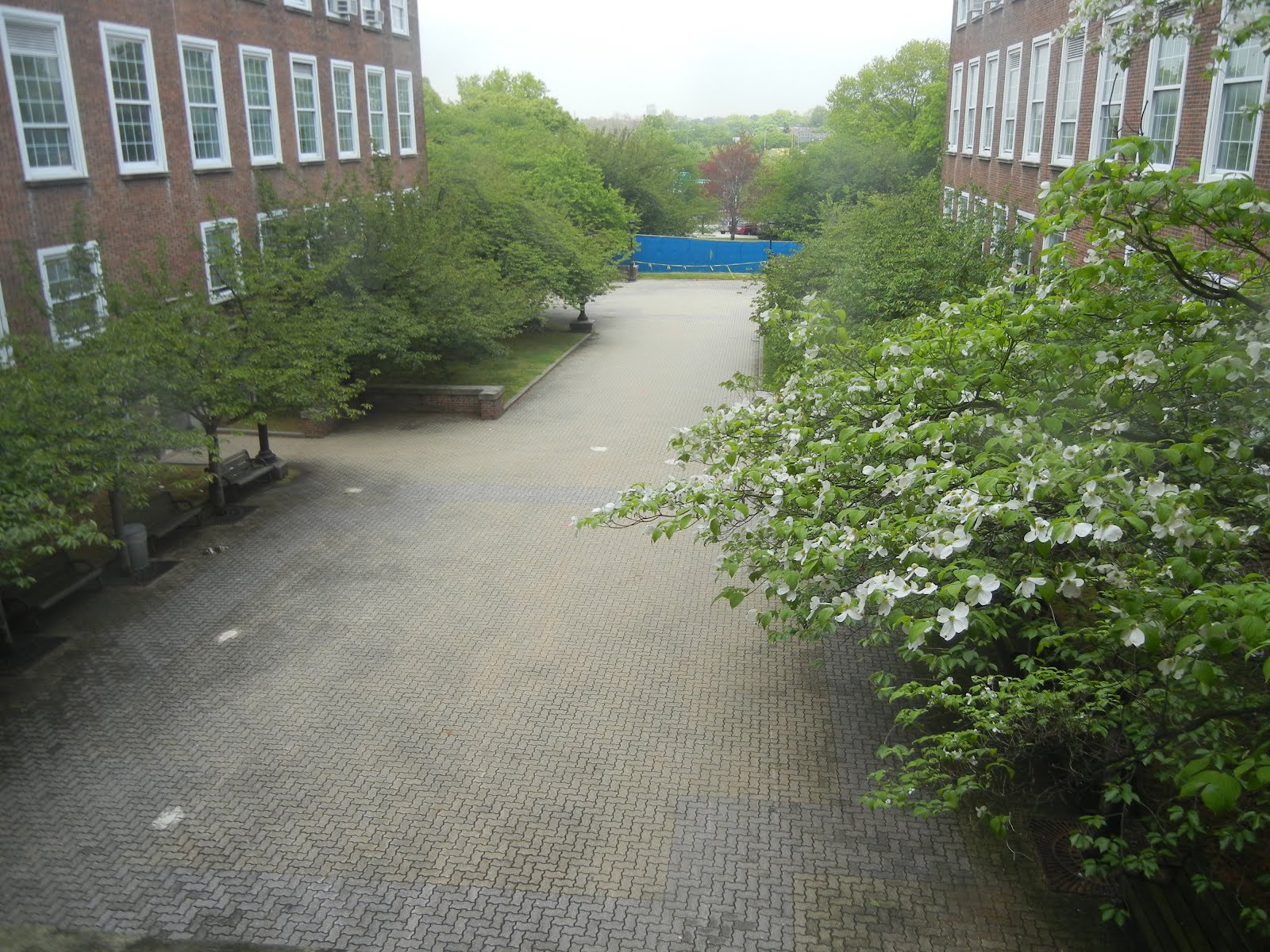
April 2012 - The scene days after the cherry trees were destroyed to make for the atrium construction staging area.
May 1, 2012 - The evidence has been removed the stately Oak tree has awoken from its Winter slumber.
Read More:
Queens Chronicle - May 10, 2012 - by Michael Gannon
NY 1 - May 8, 2012 - By CeFaan Kim
E-mail shows city hacks were wrongNew York Post - May 6, 2012 - By Kate Briquelet
gothamist - May 7, 2012 - By John Del Signore
A Walk In The Park - Apil 12, 2012 - By Geoffrey Croft
Walk In the Park - April 3, 2012
A Walk In The Park - April 1, 2012 - By Geoffrey Croft