Showing posts with label Julissa Ferreras. Show all posts

Tuesday, February 11, 2014

Lawsuit Filed To Stop Mega-Mall In Flushing Meadows-Corona Park


The Bloomberg Administration and the City Council are attempting to hand over 47. 5 acres of Flushing Meadows - Corona Park worth $ 1 billion dollars to The Related Companies and Sterling Equities to build a 1.4 million sq. ft. mall known as Willets Point West. They are attempting to push this through without receiving any approvals or even voting on the massive project.  

Queens

A coalition of area residents,  environmental groups, business and home owners, and State Senator Tony Avella filed a lawsuit in New York County Supreme Court on Monday demanding the City halt its illegal handing over of mapped Parkland to build a mega-mall.

The suit also asks the Court to nullify actions taken by the Planning Commission, and approved by the Council in October of last year, to permit construction of parking facilities in Willets Point in lieu of the affordable housing and supportive facilities called for by the 2008 plan. 

The complaint alleges that the project cannot proceed without approval by the State Legislature under the “public trust” doctrine that protects all parkland throughout the State against non-park uses without the consent of the Legislature which was not requested or obtained.

The Bloomberg Administration and the City Council are attempting to hand over 47.5 acres of Flushing Meadows - Corona Park in Queens worth $ 1 billion dollars to The Related Companies and Sterling Equities to build a 1.4 million sq. ft. mall known as Willets Point West.   They are attempting achieve this without receiving any approvals or even voting on the project.  

The complaint also alleges violations of the City’s Zoning Resolution and Charter, and seeks annulment of approvals granted by the City to date for the related Willets Point plan.

In October the City Council approved zoning amendments to the Willet's Point plan,  allowing a multi-phased development and temporary parking on part of the Willets point site.   These amendments however do not permit the building of a massive 1.4-million-square-foot shopping mall much less a massive 1.4 million square foot shopping mall on mapped parkland.


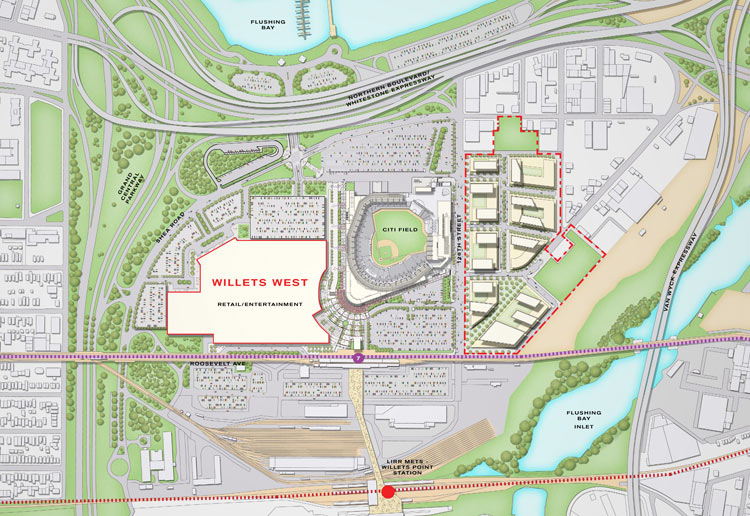
Related Companies and Sterling Equities are attempting to build a 1.4 million square foot mall on 47.5 acres of mapped parkland in Flushing Meadows-Corona Park, west of Citi-Field stadium.  This represents the largest public parkland giveaway in recent history. The proposed project would allow the seizing of the public parkland to be used exclusively for non-park purposes without first getting State Alienation approval as is required under the law.  The construction of such a mall on public parkland would be unprecedented. (Photos: Geoffrey Croft/NYC Park Advocates) 


The Bloomberg administration and the City Council are attempting to bypass land use procedures including the Uniform Land Use Review Procedure (ULURP),  and  state law which requires State Alienation legislation approval to use parkland for non-park purposes.   Mayor Bloomberg claimed all land use powers of the former Board of Estimate as belonging to him, clearly a violation of ULURP.  

From 1964 to 2006,  30.7 of the 47.5 acres of the site near the northerly end of the Park was occupied by Shea Stadium.  When Shea was demolished and replaced in 2009 by Citi Field at a location slightly east of the Shea site, the project site became a parking field for visitors to Citi Field.  The site has also been used for a variety of public recreational events including foot races, circus performances, an annual wheelchair baseball game, and concerts.

In 2012, Sterling Equities and the Related Companies convinced the Bloomberg administration to allow the massive shopping mall on Park property.

In October Council member Julissa Ferreras attempted to justify and explain why the public parkland was now part of the deal and was given away - the developers and the Mayor wanted it.   

"The mall is something that the developers and the administration believe is necessary to be able to support the build-out of Willets Point,"  she said.  

In 2008 the City Council approved a Willets Point plan to place the intended retail development in the neighboring Willets Point development project along with affordable housing, the Park was never part of the project.


Delivering The Deal.  Big Winners. A beaming Related Companies' Charles  J.  O'Byrne, Queens City Council member Julissa Ferreras,  Jeff Wilpon - New York Mets COO and the executive vice-president of Sterling Equities and son of New York Mets principal owner Fred Wilpon, and Glenn  A. Goldstein - president of Related Retail and registered lobbyist pose on October 8th shortly after the City Council vote. (Photo: William Alatriste /New York City Council) 


“Parks are intended to serve the people, to provide open space, landscaping, opportunities for recreation, playgrounds for children, and escape from the hordes and noise of a busy commercial city," said State Senator Tony Avella, a plaintiff in the suit.   

"The only commercial uses that belong in them are those, such as snack stands, that enhance the park experience.  A shopping center is not one of them.  We have a wonderful law that is supposed to assure all of this, known as the ‘public trust doctrine.’  I’m outraged when the people who are supposed to administer parks for everyone turn them over to private interests without seeking the State Legislature's consent as the public trust doctrine requires.  So, I am very pleased to be a party to this action.” the Senator said.

The contention that the 1961 law exempts this transaction from the public trust doctrine, says John Low-Beer, one of the plaintiffs’ lawyers, is wrong. 

“The 1961 law was intended to allow a stadium and uses directly related to a stadium, such as parking, concessions, and other commercial activity typically incidental to a professional sports arena.”

Low-Beer adds that the 1961 law “says nothing about a shopping center.  In fact, the Legislature explicitly prohibited any purely commercial uses other than ones strictly related to the stadium, such as concession stands.  The public trust doctrine requires that any legislative consent be very specific about what it will allow.  If it doesn’t specify a use, then that use is not permitted.”

The suit was filed on behalf of State Senator Tony Avella, The City Club of New York, NYC Park Advocates, a City-wide parks advocacy group that helped to establish “Save Flushing Meadows Park.” 

The plaintiffs include Paul Graziano, Ben Haber, and Alfredo Centola who have prominently opposed a spate of recent proposals for new or enlarged sports venues in the Park, as well as the shopping center.

The efforts of “Save Flushing Meadows Park,” a coalition of many Queens civic groups and individuals helped thwart the proposed professional soccer stadium, though it was unable to stop a half-acre expansion of the Tennis Center.  Several of the plaintiffs have also led opposition to the shopping center.

Other plaintiffs are individuals and businesses falling into several categories including nearby residents, park users, and businesses along Roosevelt Avenue and in Willets Point having special concerns about traffic and business displacement.

The efforts of the “Save Flushing Meadows Park” group were recently bolstered by the City Club which took on the shopping center as a major project after successfully participating in a campaign to defeat a proposed upzoning of the East Midtown area around Grand Central Terminal that would have doubled the permissible bulk in much of the area.  After Council leaders announced in early November that the Council would vote against the plan, Mayor Bloomberg withdrew it.

Michael Gruen, President of the City Club, said that the City Club joined the shopping center fight out of concern that “Flushing Meadows Park has long suffered from neglect in maintenance and from getting eaten away as a recreational park by a voracious assumption that every new idea for a commercial sporting activity should be given a home in this one Park.

The proposed  1.4 million square foot retail and entertainment development was approved by the City Planning Commission on Wednesday.


Fortunately some of the worst, such as a proposed “grand prix” race track around the lake, have been defeated.  But this is a beautiful park and it deserves much better treatment.”

Gruen added that the City Club sees the shopping center project as “perhaps the most egregious example of commercialization of parkland throughout the city.  There are places where the annual cycle of fashion shows and holiday bazaars leave little time for enjoying the open space and landscaping. That it is the worst of a pattern of treating parkland as an asset to be sold off for commercial use caused us to take it on so that we could get the courts to draw a clear line:  commercial uses that do not enhance the recreational experience of parks do not belong in the parks.”

Gruen said that the City Club hopes “clearly to confirm that any alienation of parkland requires legislative action, very specifically stating what uses are to be allowed.  The legislative consent must then be construed narrowly by the courts so that ambiguities in statutory language cannot be exploited, as the developers here are trying to do, to justify other commercial uses that the legislature had no evident intention of condoning.”

The case is filed in the New York County Supreme Court.  John Low-Beer, Lorna Goodman and Meredith Feinman represent the plaintiffs.

The complaint asks the Court to declare that the shopping mall project is illegal and to enjoin further steps toward its construction without compliance with applicable law including the public trust doctrine, and without imposing appropriate zoning regulations on the site.

It also asks the Court to nullify actions taken by the Planning Commission, and approved by the Council in October of last year, to permit construction of parking facilities in Willets Point in lieu of the affordable housing and supportive facilities called for by the 2008 plan.  The complaint asserts that the Commission and Council knew that the changes in the Willets Point plan were needed for no other purpose than to accommodate stadium parking displaced by the intended shopping center, and knew that the shopping center project itself is illegal without approval of the legislature.

They knew that their action would facilitate illegal construction of the shopping mall, the promoters of which had clearly stated their belief that they could proceed with without legislative approval.  The Commission and Council thereby acted illegally, and arbitrarily and capriciously.

The Related Companies and Sterling Equities just got approval to build this mall on the western parking lot of Citi Field.
The proposed mall across from CitiField.

Read More:


New York Post  - February 11, 2014 - By Minsi Chung

New York Daily News -  February 11, 2014 - By Beth Stebner   

Queens  Chronicle -  February 10, 2014  by Peter C. Mastrosimone 

DNAinfo - February 11, 2014 - By Katie Honan

City Limits - By Patrick Arden

Legal questions emerge about Citi Field mall 
City Limits - By Patrick Arden
Facebook


Sunday, November 3, 2013

Willets Point Lessons: Trading Parkland for Developer's Donation


Sorry, image not available
Delivering The Deal.  A beaming Related Companies' Charles  J.  O'Byrne, Queens City Council member Julissa Ferreras,  Jeff Wilpon - New York Mets COO and the executive vice-president of Sterling Equities and son of New York Mets principal owner Fred Wilpon, and Glenn  A. Goldstein - president of Related Retail and registered lobbyist, pose on October 10, 2013 shortly after a City Council vote. (Photo: William Alatriste /New York City Council via A Walk In The Park)

In the second of part of a series on a development process that spanned much of the Bloomberg administration, City Limits looks at how parks fare under this deal—and others.

City-Wide

Immediately after the City Council approved the redevelopment of Willets Point early this month, Queens Councilwoman Julissa Ferreras posed at the front of the chambers for a celebratory photograph with the developers. She had brokered the final deal only hours before in the Bloomberg administration's offices at City Hall—and inadvertently paved the way to a troubling future for New York City parks, according to an article in City Limits. 
Private money for a neglected park was at the center of Ferreras' deal with the Willets Point developers, who would be drawing on free land and taxpayer subsidies worth more than the entire annual budget of the city's Parks Department.

The developers—Related Companies and Sterling Equities, the real estate firm of Mets' owners Fred Wilpon and Saul Katz—agreed to contribute $15.5 million over 25 years to the Flushing Meadows Corona Park Alliance, a nonprofit Ferreras had just founded with the Parks Department and the group New Yorkers for Parks.
The Willets Point plan involves the building of a 1.4 million-square-foot shopping mall and multi-story parking garages on 46 acres of mapped parkland at the northern end of Flushing Meadows. Even as the proposed mall encountered neighborhood opposition—Community Board 3 voted 30-1 to reject the plan—Ferreras was actively soliciting funds from the developers.
"They know I expect them to contribute," she told City Limits this summer, pointing out that the Mets' stadium was already located in the park. If the team's owners wanted to build their mall there too, she said, they would have to give money to her nonprofit. "I am knocking on their door." Months earlier, Ferreras' park alliance had accepted $10 million over 23 years in exchange for her support of the U.S. Tennis Association's expansion in Flushing Meadows.
In many ways, the Flushing Meadows deals are emblematic of a larger predicament in city parks: For years, the government has inadequately funded parks, so private money has helped to pay for park upkeep.


Related Companies and Sterling Equities are looking to build a 1.4 million square foot mall on 48 acres of mapped parkland in Flushing Meadows-Corona Park, west of Citi-Field stadium.  This represents the largest public parkland giveaway in recent history. The proposed   Willets Point West Mall project would allow the seizing of the public parkland to be used exclusively for non-park purposes without first getting State Alienation approval as is required under the law.  The construction of such a mall on public parkland would be unprecedented. (Photos: Geoffrey Croft/NYC Park Advocates) 

That money usually gravitates to affluent neighborhoods, leaving parks in poorer areas behind. This time, in Flushing Meadows, a park in a lower-income area is getting in on the action, but on different terms: Parkland is effectively being traded to a private company for money to maintain the park that's left.
Our grass, their greenbacks
The amount of private money now paying for New York City parks is staggering. Parks Commissioner Veronica White put the figure at $76 million a year during a recent City Council hearing, but documents obtained by City Limits via the Freedom of Information Law indicated that 26 private groups alone contributed an annual $162 million in 2011 for parks' maintenance and operations. If accurate, that's equal to more than half of the city's yearly tax-levy budget for parks. The Parks Department did not answer questions about these numbers.

*   *    *
Read the rest of this series:
Part 1:
Will a New Mayor Do Development Differently?
Part 3:
Relocation Fears for Workers

*   *    *

The city claims the private investment allows it to target limited taxpayer resources to the parks most in need, but critics say the use of private funding has encouraged a further winnowing of resources to the Parks Department and created growing disparitiesamongparks for the haves and have-nots .
While Manhattan and Brooklyn have ended up with some showplace parks, no one is interested in operating, say, Highland Park on the Brooklyn-Queens border or Ferry Point Park in the Bronx. Donald Trump has struck a deal to take about half of the 413-acre Ferry Point to build a private club and a "world-class" golf course on what had been a garbage dump , but he won't be sharing the revenue with the park, and it's unlikely the patrons of his luxury facility will be the residents of the neighboring public housing project.
Even middle-class and well-heeled areas have been forced to pick up the slack, with volunteers maintaining such parks as Juniper Valley Park in Middle Village, Queens, and Dag Hammarskjold Plaza in Manhattan, right across the street from the United Nations. Half of the city's 1,800 parks and playgrounds now depend on some type of private group to at least chip in on maintenance, according to the Parks Department, but many, if not most, of these groups struggle.
Some people, like Public Advocate and mayoral candidate Bill de Blasio, have pinned their hopes for more equitable parks funding on legislation proposed by state Senator Dan Squadron that would create a Neighborhood Parks Alliance to take 20 percent from the budgets of large park conservancies and distribute that money to the parks most in need. "It will make for a fairer city," says de Blasio, "and I think it's a great idea."
But the proposed alliance would be blocked from accessing a large part of the nonprofit funds, says James J. Fishman, a professor at Pace Law School. Endowments would be off-limits, and if donors make restricted gifts, then that money can't be diverted to another use. Nonprofit-law experts consulted by City Limits say the legislation is sure to face legal challenges.
Fact is, the proposed fund would draw from the same private-money system that led to the great disparities it seeks to correct, and the redistribution of money simply won't be enough to right the deeper wrongs. There is no such thing as a free lunch: Taxpayers still cover a portion of the budgets for even the biggest park conservancies, and that means they would end up funding the Neighborhood Park Alliance too. In the end, most public parks remain the responsibility of the public.
More land, less labor
While Bloomberg's borrowed $6 billion over the last 12 years to build new parks and improve existing ones, upkeep relies on the operating budget, and the mayor has consistently allocated 0.5 percent or less of the city's tax-levy budget to maintain parks, which account for 14 percent of the city's surface area.
In contrast, back in the days of Robert Moses, parks maintenance and operations routinely claimed about 1.5 percent of the operating budget. Even under Ed Koch, with the city barely out of the fiscal crisis, roughly 0.8 percent went to parks. Bloomberg has regularly proposed budgets with even smaller shares.
Last year, a Parks Department internal review appealed for the city to hire 682 more workers. In response, Bloomberg paid at least $675,000 for the consulting firm of Pricewaterhouse Coopers to evaluate how the department deploys its current workforce and resources to maintain parks. "The mayor wanted justification," explains one Parks Department employee who requested anonymity in this article. Imagine Bloomberg's surprise, then, when Pricewaterhouse Coopers found the Parks Department needed to hire even more workers than had been requested.
The reasons why are revealed in e-mails and a PowerPoint presentation, titled "Parks Operations for the 21st Century," based on the consultant's report, obtained under the Freedom of Information Law. The publicly financed documents were heavily redacted, but what remained visible among the blacked-out pages painted an ugly picture.
"Over the last five years," the consultants noted, maintenance and operations staff had "decreased by 13%," as the agency was "in full attrition," meaning it was not replacing workers who had left or retired. The mayor's management report showed a more precipitous drop from 2009 to 2012, with total personnel – including both full-time and full-time equivalent staff – falling by 24 percent. Some parks have always fared worse than others. Over the course of Bloomberg's 12 years in office, the full-time maintenance staff at Flushing Meadows Corona Park shrunk from 35 to 13.
Most parks depend on roving crews of workers, who spend much of their time in transit. The consultants found that 54 percent of all Parks Department work-order hours were logged by JTPs—or Job Training Participants, the temporary-employment program for people on public assistance—and 91 percent of JTP time was spent on simply "cleaning," or picking up litter. "JTPs are the majority of the workforce," Pricewaterhouse Coopers noted, "because their hourly [pay] rate is much lower."
With 61 percent of work orders more than 90 days overdue, the consultants discovered bleak conditions in neighborhood parks throughout the five boroughs. Photos and eyewitness accounts captured the details: Broken drinking fountains and cracked concrete foundations, "huge amounts of dead trees made into wood chips … lots of homeless people and trash buildup … algae problems," and illegal dumping.
The Pricewaterhouse report links maintenance deficiencies to safety hazards, zeroing in on the problem of falling tree limbs. That problem appears to have grown worse in recent years, despite attracting a lot of attention. Over an eight-week period this summer, the watchdog group NYC Park Advocates counted 13 incidents of falling limbs injuring parkgoers. Two lawsuits involving diseased trees in Central Park cost the city $14.5 millionthis year.
According to Pricewaterhouse Coopers, the average response time to a complaint like "the branch is cracked and will fall" is 20 days, ranging from 9 days in Queens to 48 days in the Bronx. These endemic delays were unsurprising as well, given that the Parks Department had 91 "pruner" and "climber" jobs to take care of the city's 2.6 million trees; following the Pricewaterhouse Coopers report, 30 more were taken on. After a pregnant woman was killed by a tree in Kissena Park in August, the city said it would hire another outside consultant to look at the problem.
Pricewaterhouse Coopers ultimately discovered the city needed to hire more workers. Last January, the Parks Department had 3,329 full-time workers, and the consultants advocated a bump up of 1,910. The agency added 1,165 seasonal temps and filled 150 open positions it previously couldn't fill. In March it announced the hiring of an additional 414 full-time employees, including nearly 100 with trade skills. When all job categories are combined, the new total falls 181 positions short of the Pricewaterhouse Coopers' recommendation, says the Parks Department. According to the mayor's management report for fiscal 2013, the number of full-time parks jobs was still below the level of just three years before.   
After crime rose in parks by 7 percent in 2012—and after the Pricewaterhouse Coopers report identified staffing deficiencies—the number of Parks Enforcement Patrol (PEP) officers was almost doubled this year to 167 officers, still a far cry from a high of 450 in the 1990s, according to Joe Puleo, president of Local 983 of the municipal-employee union DC 37, which represents city parks workers, including PEP officers.
He welcomes the additional hires, but thinks they are still far too few to patrol the city's 29,000 acres of parkland. "Everybody knows the Parks Department is massively understaffed, but Bloomberg had to spend all of this money to identify the obvious," he says, referring to the pricey Pricewaterhouse research.
Revenue leaves
Last year, Bloomberg put White, the former head of his Center for Economic Development, in charge of the Parks Department. At the announcement, he stressed the central role of public-private partnerships and corporate sponsorships in future park operations: "Otherwise we won't be able to afford all the things we're trying to do."
But at the same time Bloomberg was refusing to hire more workers, in 2009, parks were generating in excess of a record $110 million a year from concessions, lease agreements, recreation fees, and special-event rentals. All of this money went into the city's general fund, not into parks.
Meanwhile, the administration permitted some private entities to profit handsomely off parks. For ten months a year—from August to June—the city allows Lincoln Center to rent out the 2.4-acre Damrosch Park and to keep all of the revenue from it, estimated to be about $9 million annually, according to a recent lawsuit by residents near the park.
Over at the Madison Square Park Conservancy, founding board member Danny Meyer runs a multimillion-dollar business in the park. His Shake Shack pays a percentage of its revenue to the city and the conservancy, but that share is a fraction of what park concessionaires normally pay. Even with his sweetheart deal, Meyer picked up an additional $47,080 from the conservancy in 2011, according to the nonprofit's last available tax filing.
By law, all concession revenue is supposed to go to the city's general fund, but the Bloomberg administration has increasingly allowed select nonprofit park groups to take a cut. Back in 2006, the Central Park Conservancy renegotiated its contract to keep a greater percentage of its park's concession revenue, which has resulted in millions of extra dollars. The High Line effectively gets to keep all of its concession revenue, even from concessionaires on the street below the park.
Bloomberg continues to push for more commercial enterprises in parks. Back in 2004, the mayor responded with a shrug to protestors of another Meyer-related project—a plan to establish a high-end restaurant in Union Square Park, backed by a multimillion-dollar anonymous donation. Bloomberg asked, "How do you expect us to pay for parks?"
In Queens, fears of a precedent
Though Ferreras compared her new nonprofit to the Central Park Conservancy and the Prospect Park Alliance, she had created a new model, funded not by philanthropic contributions but by extracting money from businesses that want parkland.
When Ferreras told City Limits of her plans to ask the Willets Point developers for money, she listed other businesses located in the park, including the Mets and the Terrace on the Park banquet hall, noting that all of these businesses already operate under agreements with the city—the Terrace on the Park, for example, pays the city $2.5 million a year, or $100,000 more than the U.S.T.A.
But some park advocates fear Ferreras's forging of separate deals will now set a dangerous precedent, encouraging more development in underfunded parks. The Willets Point deal was "shameful," according to Richard Hellenbrecht, president of the Queens Civic Congress, an umbrella organization of 106 civic and community groups. The Congress opposed the mall plan not only for its taking of parkland but for the harm it could cause to local small businesses, not to mention the likelihood of more traffic and congestion.
"It's taking parkland, mapped parkland," Hillenbrecht says of the "Willets West" shopping mall. "It makes me angry. I worry about this in a lot of ways, and it upsets me that it could have been approved so quickly, ignoring all the concerns of Queens residents. We're going to have a new administration in a few more months. Why couldn't it wait?"
Several community groups have told City Limits they're contemplating a lawsuit over the city's claim that the shopping mall is permitted under a 1961 law that allowed for the financing of Shea Stadium. They claim the administration wants to avoid the burden of alienating that parkland, which would require state legislation to strip the land of its legal protections. Alienation legislation mandates the replacement of lost parkland or a payment for other park improvements equal to the land's fair market value.
As for the combined $25.5 million for Flushing Meadows from the mall and tennis projects, more than half of it will be spent on one-time capital improvements while the rest gets spread over two decades. That might sound like a lot of money, but it amounts to an annual $550,000 over most of the life of these two deals.
"That really won't do much," Hellenbrecht says. "It might pay for some more staffers, but not many. It's not enough to make a dent in what needs to be done, either operationally or even capital-wise. It's better than nothing, but I'd rather not have somebody taking parkland."
This article was reported in partnership with The Investigative Fund at The Nation Institute.

Read More:

Lessons of Willets Point: Trading Parkland for Developer's Donation
City Limits - November 1, 2013 - By Patrick Arden

Thursday, October 10, 2013

Related Co. Strikes Gold As City Council Approves Park Land Grabs Deals - Willets Point West & Ruppert Playground Development Approved

"The mall is something that the developers and the administration believe is necessary to be able to support the build-out of Willets Point."  -  Julissa Ferreras


Delivering The Deal.  Big Winners. A beaming Related Companies' Charles  J.  O'Byrne, Queens City Council member Julissa Ferreras,  Jeff Wilpon - New York Mets COO and the executive vice-president of Sterling Equities and son of New York Mets principal owner Fred Wilpon, and Glenn  A. Goldstein - president of Related Retail and registered lobbyist, pose shortly after the vote. (Photo: William Alatriste /New York City Council)


Queens/Manhattan


By Geoffrey Croft


Step Right Up For the Great Land Giveaway.

As expected the Bloomberg administration-friendly Related Companies made out like bandits yesterday afternoon as the City Council  voted nearly unanimously to approve two controversial projects involving the use of park land.

The City Council is handing over 48-acres of Flushing Meadows - Corona Park in Queens for Related Companies and Sterling Equities 1.4 million sq. ft. mall known as Willets Point West without having to approve or even vote on the project. 


Yesterday the City Council approved zoning amendments to the Willet's Point plan,  allowing a multi-phased development and temporary parking on part of the Willets point site.  These amendments however do not permit the building of a massive 1.4-million-square-foot shopping mall much less a massive 1.4 million square foot shopping mall on mapped parkland.  

The Bloomberg administration and the City Council are attempting to bypass land use procedures including the Uniform Land Use Review Procedure (ULURP),  and without seeking State Alienation legislation as is required under state law to use parkland for non-park purposes.     

Mayor Bloomberg claimed all land use powers of the former Board of Estimate as belonging to him, clearly a violation of ULURP.  


The City Council approve the proposed Willets Point West Mall location. Related Companies and Sterling Equities are looking to build a 1.4 million square foot mall on 48 acres of mapped parkland in Flushing Meadows-Corona Park, west of Citi-Field stadium.  This represents the largest public parkland giveaway in recent history. The proposed project would allow the seizing of the public parkland to be used exclusively for non-park purposes without first getting State Alienation approval as is required under the law.  The construction of such a mall on public parkland would be unprecedented. (Photos: Geoffrey Croft/NYC Park Advocates) Click on images to enlarge.


The City Council also approved a text change that would allow the powerful development company the right to build a 36-story luxury building on a beloved community park on the Upper Eastside of Manhattan.

There are also number of legal issues surrounding both of these projects.

Willets Point West Mall Project on Park land

The mall project is part of the proposed $3 billion Willets Point megadevelopment. The majority of the land would be taken from the public parkland.  

Not surprising the parkland connection to the Willets Point West development was never mentioned during the public hearing.

The first City Council committee vote began three hours late as last minute details were feverishly being hashed-out behind closed doors between the applicants and  administration officials.  Members of  the Related team were seen repeatedly disappearing into the Executive side of the building. 

When the dust settled the Borough of Queens lost  48-acres of public parkland to one of New York’s biggest real estate developers so they can built the city's largest mall on public parkland.

In exchange for the approvals  the developers agreed to give $15.5 million to the Flushing Meadows-Corona Park Alliance,  a public-private conservancy  Queens Council member Julissa  Ferreras is currently in the process of creating with the help of New Yorkers For Parks.   


Sign Of the Times.

Eight million dollars will go towards capital improvements for the park and the rest will be distributed over 25 years the Council woman said afterwards.

The money will initially be handled by the City Parks Foundation until her Alliance is set up.   

Julissa Ferreras delivered the deal and thanked the groups that helped make it possible, Make the Road,   Queens Fairness Coalition and New Yorkers For Parks.    

Moments after the Full Land Use committee vote a proud and jubilant Ferreras did a victory lap in the new renovated Council Chambers where she was greeted by a host of well-wishers. 

One of her first stops was a mutually congratulatory visit to the Related Companies and Sterling Equities team who were sitting up front.  She posed for a photograph with a beaming NY Met's COO and executive vice-president of Sterling Equities Jeff Wilpon, who had been sitting with Related executives Charles  J.  O'Byrne - senior vice president ,  Glenn  A. Goldstein,  president  of Related Retail and registered lobbyist, and Related Companies' go-to land-use attorney Jesse Masyr. 

Ferreras made her way to the back of the room where she chatted with a glowing Holly Leight, a former Bloomberg administration official and current executive director of  the Parks Department partner group New Yorkers For Parks. 

Land use Chair Leroy Comrie said he wanted to,  "especially thank all the advocates that came and made sure the projects were done to their concerns. They were heard and listened to as part of process," he said with a straight face. 

Staten Island Council member Vincent Ignizio tried his best to stick up for his colleagues. 

"I also want to point out that very often the media portrays this body in a negative light but what you see here today is the hard work of council members who stood up for their principles, stood up for their community and ultimately got a great deal,"  Ignizio said during the Subcommittee on Zone &  Franchises vote.  


The proposed mall on parkland property was never part of the original Willets Point development that was approved in 2008. 

The most telling and disturbing comments relating to lack of accountably and desire to protect the 48 acres of public parkland however came after the vote,  and after an hour and half delayed press conference.  

Council member Ferreras attempted to justify and explain why the public parkland was now part of the deal and was given away - the developers and the Mayor wanted it. 

"The mall is something that the developers and the administration believe is necessary to be able to support the build-out of Willets Point,"  she said.

"Willets West is what its known as, the mall and entertainment center.   It's currently on a parking lot and that is through the lease with the New York Mets, who is also part of the joint venture,"   Ferreras said, being careful not to refer to the property as parkland.  

"I really do believe that we're going to have a wonderful new community at Willets Point."

Calling it a "real park investment," the Councilwoman also mentioned the other deal she recently negotiated with the USTA. That deal allows the tennis giant the right to take additional parkland and destroy up to 400 trees in exchange for $ 10 million dollars, with only  $ 5 million in "expense" dollars to be spread out over 20 years. That deal too will also eventually be administered by the Flushing Meadows-Corona Park Alliance. 

No announcement was made however on the city allocating proper funding for the park.


The Related Companies and Sterling Equities just got approval to build this mall on the western parking lot of Citi Field. 
Proposed Nightmare - Willets Point West.   The Related Companies and Sterling Equities just got approval from the City Council to build a 1.4 million square foot mall as part of a 48 acre project in Flushing Meadows-Corona Park.


This Alliance model,  as it has been repeatedly pointed out,  relies heavily on commercial businesses exploiting the park as a major funding stream. 

Critics of the Willets Point West plan argue that if the mapped parkland being proposed for mall use are no longer needed for Citi-Field parking then it should revert back to its original recreational use.   

There are also number of legal issues surrounding the attempted disposition of this public land.

"I'm really angry and disgusted," said Richard Hellenbrecht president of Queens Civic Congress,  which represents a coalition of more than 100 civic and other community organizations throughout the borough of Queens. 

"I am angry, disappointed and upset that the City Council so easily agreed to turn public land, indeed mapped parkland, over to private interests for profit-making development through some behind closed-door deals and buy-outs.  In just one month the current administration will be lame duck and a new set of eyes can consider what's best for the city, our communities and especially our precious parkland.  There should be no need to rush through a deal that will permanently remove 48 acres of parkland and create unnecessary competition to hundreds of small businesses in central Queens.  The reasonable issues and concerns of numerous civic, parks and business advocacy groups have been ignored to offset promised development costs.  Let's see that happen in Central Park!"

Only three Councilmen — two from Queens,  Daniel Dromm, and Dan Halloran, and another from Brooklyn - Charles Barren  — voted against the plan. 


Manhattan

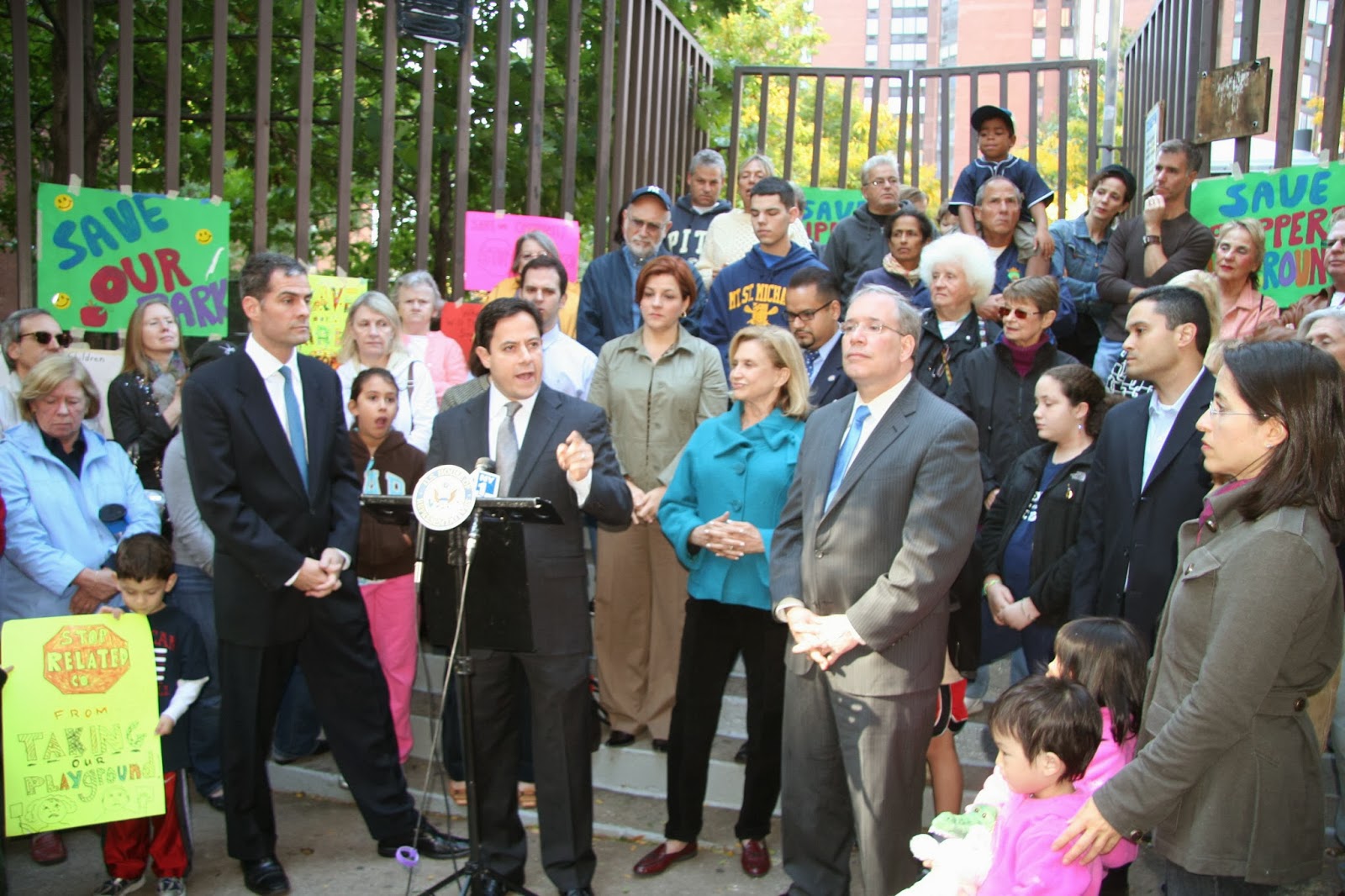
Meanwhile Yorkville residents blasted City Council member Dan Garodnick's decision to sell out the community and allow the Related Companies to build on a beloved park.


"Let me in." Children in front of the locked Ruppert Playground.   Ruppert Playground - located between East 92/93rd Street btw. 2nd & 3rd Avenues.  Community Board 8 is the city's most densely populated community and ranks dead last in publicly accessible open space. 


The City Council,  lead by area councilman Garodnick,  voted nearly unanimously to approve a text change that would allow Related Companies to build  a 36-story luxury building on a neighborhood park.  

Community Board 8 is already the city's most densely populated community and ranks dead last in publicly accessible recreational space. 


Ruppert Playground. The City Council approved voted to allow the Related Companies the right to replace a beloved park with a 36-story luxury building.   Previously Related Companies did not have the legal right to build on the popular playground located in Yorkville.  The law states that any proposed development on the park requires the consent of surrounding buildings in the original Ruppert Urban Renew area.  Despite vehement community opposition local City Council member Dan Garodnick backed the Related Company.  


The use of Ruppert Playground CAN NOT be changed unless a previous-approved Large-Scale Residential Development Plan under the Ruppert Brewery Urban Renewal Area is amended which Related did by asking the City Council for a text change. 

The law states that any proposed development on the park requires the consent of surrounding buildings in the original Ruppert Urban Renew area. The Related Companies is attempting to take away that right by applying for a "text change"  without getting the consent of the other property owners within the boundaries of the original Large-Scale plan.

"The technical question before the Council today was whether Related should be required to obtain consent from every owner within the large scale residential development area in order to use its development rights, " Dan Garodnick said is a prepared statement.

Apparently he didn't they had to.   

Despite vehement community opposition City Council member Dan Garodnick backed the Related Company and approved the text change.

The community has waged a three-year battle to prevent Related from building on the park.

The nearly one acre park, which opened in 1978 using Federal Community Development Block Grants,  is located on E.93rd street.

"It is with great disappointment that after years of supporting the community and they him that Council Dan Garodnick has chosen not to side with his constituents when they needed him the most," said Oscar Fernandez of Save Ruppert Playground.     

"I worked closely with Dan over the last few years and he always seemed like a person that would put his community first but in this case he did not and that is most disappointing of all.     Dan always asked us to put together a sound legal position for being able to vote no to the text change and the team at much effort did so however he has still falling on the wrong side of the law in preserving this treasured open space for his community." 

"If Related had an absolute and unquestioned right to develop on this property as they saw fit, why was any vote required?  Please explain this to me,"  Yorkville resident Scott Usiak wrote to Garodnick.

"You are still my council member. Now that you have voted "yes" to the text amendment, can you at least provide us with some clear and specific steps you intend to take to make our lives better," he asked.     

Mr. Usiak called the letter he received from the Council member explaining his decision, "disingenuous and misleading."    

"Given your frequently stated position that the area suffers from population density issues and a lack of open space, what will you do to demonstrate that anything you said was genuine, rather than material for press releases and local news interviews?" 

The application passed the City Council today by a vote of 44 to 2, with future Manhattan Borough President Gale Brewer voting against it - she came through on her promise. Brooklyn's Charles Barren also voted against it.   


Dan Knows Best. City Council member Dan Garodnick addressing the crowd in Ruppert Playground in 2011.  The law states that any proposed development on the park requires the consent of surrounding buildings in the original Ruppert Urban Renew area.  He disagrees.  Yesterday Dan voted to give Related Companies  a "text change"  which gives the developer the right to build without getting the consent of the other property owners within the boundaries of the original Large-Scale plan.   


Dan Garodnick addressing the crowd in front of the locked Ruppert Playground.


 Where Are They Now. Still standing with the Communty?

Read More:


Related Co. Expected To Win Big Today At City Council Land Use Votes

A Walk In The Park - October 9, 2013 - By Geoffrey Croft


A Walk In The Park - August 9, 2013 - By Geoffrey Croft   

A Walk In The Park - September 30, 2013

Save Ruppert Playground

Facebook