

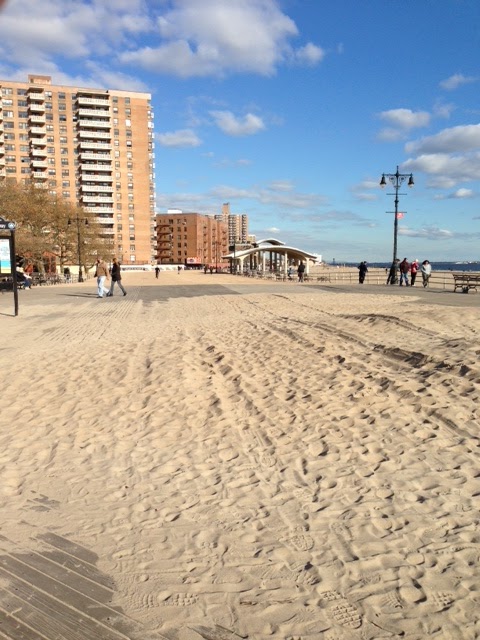
Sections of concrete boardwalk were destroyed during the storm. As with the wooden boardwalk they were also not fastened to the concrete foundation. Government officials have attempted to portray the concrete boardwalk as having escaped unscathed during the storm as opposed to the wood. (Photos: Geoffrey Croft/NYC Park Advocates) Click on images to enlarge.


By Geoffrey Croft
A number of important questions remain regarding the re-building and future of Rockaway Beach and its historic boardwalk.
Approximately eighty-percent of the 5.5 mile boardwalk was separated from its concrete foundations and carried away by the powerful tidal surge during Hurricane Sandy. Some sections were found blocks away.
Mayor Bloomberg however weighed in over the controversial issue of replacing the city's wooden boardwalks with concrete with his opinion.
"I guess this settles the issue of wooden boardwalks versus concrete boardwalks. There will be no more wooden boardwalks in Rockaway or anywhere else," the Mayor said.

City Councilman Eric Ulrich, former Parks Department employee and current Deputy Mayor for Operations Cas Holloway, and Mayor Michael Bloomberg on Thursday with staff from The Wave newspaper.
The Mayor, along with Queens Borough President Helen Marshall and parks head spokesperson Vickie Karp were all apparently unaware that sections of the concrete boardwalk was also damaged during the storm.
"The concrete portion of our boardwalk withstood Sandy’s fury and held, sustaining some cracks,” said the ill-informed Queens Borough president told the New York Post.
Parks spokeswoman Vickie Karp said it was, "undeniable that the concrete sections of the boardwalk held up extremely well.”
City Council Member Eric Ulrich, who accompanied the Mayor on Thursday, did not respond to requests for comment on the Mayor's remarks.
Apparently Bloomberg did not mention that sections where jetties existed the wooden boardwalk survived largely intact.
For years local activists have been fighting to have jetties built exactly for these reasons.
Critics of the way the government has handled various issues in the Rockaways over the years point out that the severe damage caused by Hurricane Sandy to the boardwalk and to homes due to flooding were exacerbated by a number of preventable factors.

The powerful tide separated much of Rockaway Beach's 5.5 mile boardwalk from its concrete foundation. Surprisingly the boardwalk itself was not fastened to the concrete piers which remain in place.


The powerful tide separated much of Rockaway Beach's 5.5 mile boardwalk from its concrete foundation. Surprisingly the boardwalk itself was not fastened to the concrete piers which remain in place.

Advocates have been pushing to build jetties and replenish the beach which had severely eroded before the recent hurricane. They also point out that the boardwalk itself was not fastened to the concrete piers which not only remained in place but survived virtually unscathed.
They have also repeatedly called for the completion the Army Corp of Engineers study.
Rockaway resident John Cori said no rebuilding should go forward unless these issues are addressed.
"Unless there is a protection plan is in place it makes no sense," he exclaimed.
Friends of Rockaway Beach are holding a rally tomorrow at 1 p.m. on Beach 86th St., to get residents, beach-lovers and elected officials refocused on their “Demand the Sand” campaign.

B. 127th Street. Plenty Of Blame To Go Around.
Friends of Rockaway Beach are holding a rally tomorrow at 1 p.m. on Beach 86th St., to get residents, beach-lovers and elected officials refocused on their “Demand the Sand” campaign.

B. 127th Street. Plenty Of Blame To Go Around.
In July Coney Island and Brighten Beach residents sued the city to block the replacement of the wooden slats on its boardwalk with concrete.
"So in addition to being a certified nutritionist, Bloomberg is now a professional coastal engineer," blasted ida Sanoff, Chairperson of the Natural Resources Protective Association and an individual plaintiff in the suit.
The lawsuit seeks to compel the Parks Department to conduct a comprehensive environmental review of its plans, including a thorough analysis of the environmental impacts and a host of other issues.
The suit claims that concrete does not allow for drainage, creates a heightened risk of flooding and beach erosion during storms; The lack of drainage, in addition to damaging the concrete and plastic itself, also causes snow and rain to ice over in the winter, creating hazardous conditions. The increase in temperature from the concrete surface compared to natural wood in the summer, in addition to the glare effects the quality-of life in the surrounding community. Concrete and plastic absorb substantially less force than wood and therefore place far greater stress on the body for exercising. People who enjoy the boardwalk for running, dancing, exercising and walking will be greatly restricted in their ability to use the Boardwalk as they have for decades.
The Parks Department is hoping to have sections of the five-mile boardwalk open by summer after most of the five mile long decking became dislodged during Hurricane Sandy. The City hired McLaren Engineering Group who recently surveyed the destruction to asses what can be opened. They dispachted three groups of two who walked the entire length of the boardwalk over five days.
Comptroller John Liu has so far approved $ 25.6 Million in emergency spending to repair various beaches - Rockaway, Manhattan Beach, Coney Island, and the Shore Parkway.
“Our office has worked closely with City agencies since before Sandy struck, and will continue to do so in order to get New Yorkers back in their homes, our children back to school, our boardwalks rebuilt and our communities back to some small sense of normalcy," the Comptroller said in a statement.
His office has also approved $22 million to the Department of Sanitation for heavy equipment and staff to augment DSNY, replacement disposal capacity, heavy duty refuse clean up.
Recycling Boardwalk Wood


Jabob Riis Park - November 20, 2012. An excavator works on a pile of wood recovered from the boardwalk. The city has refused to say how much wood has been reclaimed for reuse.
Since the hurricane hit the city has been repeatedly asked whether they were recycling the tens of thousands of boardwalk slats and support infrastructure for reuse.
The Parks Department has refused to say how much or what percentage of the wood has been saved.
"Parks is sustainability driven and always looks to recycle and repurpose materials when possible," the Parks Department said in a vague statement to A Walk In The Park this week.
"For example, in Rockaway Beach we have identified sections of boardwalk that can salvaged by our contractor and placed them in a storage compound in Jacob Riis Park for future use. This future use has not yet been determined."
Both the Parks department and the Department of Sensation were asked if only the Parks Department contractor — out of dozens working on the site - were required to save the wood.
Parks was also asked how large its storage compound was. They did not respond despite repeated requests.
The Department of Sanitation referred questions to Parks.
Rockaway Vs. Coney Island
Brighton Beach resident Ida Sanoff said comparing what happened in Rockaway to Coney Island during the storm is apples to oranges.
"Rockaway is a barrier island the water there is much rougher than at Coney/Brighton under normal conditions. That's why Rockaway has a surfing beach and Coney doesn't. Also, did you ever wonder why so many people drown in Rockaway. Not only is the water rougher, but there is a fast moving, deep water, artificial channel right near the shore. The Army Corps of Engineers dredges it like clockwork every two years. But of course, no one ever wants to talk about ways in which the channel influences the currents and rip currents right along shore, because this is a Federally navigation channel."

Brighton Beach Boardwalk After The Storm. A comparison of conditions on the concrete section of the Boardwalk (background) and the wooden section adjacent to it. Ms. Sanoff questions why conditions are so different from one surface to the other. Sand has accumulated on the wood, but not on the concrete. In addition, sand has eroded from under the concrete section while at the wooden section, sand has not eroded but has accumulated. She said this indicates that something different occured when the wave hit the different surfaces. Acitvists have long claimed that the concrete would concentrate wave energy while the slatted, porous, wooden surface would dissipate wave energy. ( Photo: Ida Sanof)
Sanoff said about 10 years ago a bike path was proposed for Coney Island & Brighton Beach, but the NYS Department of Environmental Conservation blocked it saying they did not want it placed on the sand because it would be in a coastal erosion zone.
"We asked the Parks Dept. to create and plant dunes to protect the shoreline and they refused, because they would not be able to remove debris with the mechanical sand sifters & they didn't have the manpower to rake out trash.
In Brighton Beach & Coney Island, you used to be able to walk under the Boardwalk. But after the damage of the Nor'easter of 1992, the beach was replenished (in 1994) and the beach was 13 feet high and about 200 feet wide but the full height was designed to be a number of feet back from the Boardwalk, with several feet of ventilation/air space beneath the wooden boards. But instead of taking measures to maintain the sand levels, the Parks Dept. succumbed to the whims of then State Senator Carl Kruger, (now in jail) who demanded that the sand be shoved all the way under the boards, to keep the homeless from getting under there, after there was a fire. The Parks Dept. did it, no questions asked.
Over the years, there was no maintenance of the beach. Millions of tons of sand blew over the Boardwalk & piled up on top of it while the shoreline was eroding. We complained at every Community Board 13 meeting, we complained to the Parks Dept. we complained to the local electeds and no one gave a damn. I can't help but wonder if there would have been less flooding if all of the sand that blew away had been properly groomed to keep more of it on the beach.
Concrete is used on offshore breakwaters to concentrate wave energy," she continued.
"We asked Parks for studies to see if a storm surge hitting a concrete Boardwalk then bouncing off the concrete buildings that abut it would increase wave velocity and/or damage. We asked Parks to determine if the existing wooden boards would attenuate wave energy and they refused. Their response? There was no way a storm surge would hit the Boardwalk and WE should do the studies!
During Hurricane Sandy she says eyewitnesses reported that the first breach occurred under the concrete.
"There is a space of several feet under the concrete where sand has eroded. There is NO sand build up on top of the Boardwalk. Adjacent to the concrete area, there is several feet of sand in the street. There is far less sand adjacent to the wood, but several inches to several feet of sand on top of the wooden boards.
Science is all about observation. What I observed is that something different happened when the storm surge hit the concrete as compared to what happened when it hit the wood. This needs to be investigated thoroughly. Before they change the composition of the miles of Boardwalk we need a full NYS Environmental Impact Study."
Ms. Sanoff pointed out another cause for concern
"During Sandy a large section of concrete from an abandoned esplanade between Manhattan Beach & Brighton Beach smashed into building on Corbin Place.
The last building on Corbin Place, a lovely 6 story building, is located right next to one of the concrete sections. The storm lifted up one concrete sections from the old esplanade and used it like a battering ram. It caused substantial damage to the building.
There were loads of wooden timbers, pier material etc tossed about by the storm. None of the other apartment buildings were sustained damage from getting hit by a piece of wood.
The Mayor makes these types of comments all the time. He has no idea what he's talking about," she said.
Read More:
New York Post - December 1, 2012 - By David Seifman
New York Times - November 30, 2012 - By Liz Robbins
New York Daily News - November 29, 2012 - By Lisa L. Coangelo
gothamist - November 30, 2012 - By garth Johnston
Cite Lack of Environmental Review
A Walk In The Park - July 12, 2012


