"...the public trust doctrine is clear that any alienation of parkland must be explicitly authorized by the legislature. No reasonable reading of Administrative Code section 18-118 allows for the conclusion that the legislature in 1961 contemplated, much less gave permission for, a shopping mall, unrelated to the anticipated stadium, to be constructed in the Park, " the court stated.
"Its focus is on the stadium, and the stadium only. There is simply no basis to interpret the statute as authorizing the construction of another structure that has no natural connection to a stadium.
The proper interpretation of the statute is critical in this case, because, under the public trust doctrine, dedicated park areas in New York are impressed with a public trust for the benefit of the people of the State, and their "use for other than park purposes, either for a period of years or permanently, requires the direct and specific approval of the State Legislature, plainly conferred.
To look past the specific examples, as respondents urge, would be to purposely ignore the clear intent of the legislature to curtail the use of this portion of the Park to a stadium," the decision stated.
The city has been desperately trying to rely on a 1961 bill that never replaced parkland used for Shea Stadium. Critics of the plan also argue that if the 48 acres being proposed for mall use are no longer needed for parking then it should revert back to its original recreational use.
The Queens Development Group hired Judith Kaye, former Chief Judge of the New York State Court of Appeals, the highest court in New York state.
In court Kaye laughable argued that retail shopping is a recreational activity.
Today's decision can be appealed to the state’s highest court. Because the Appellate Division voted unanimously the Court of Appeals must agree to take the case.
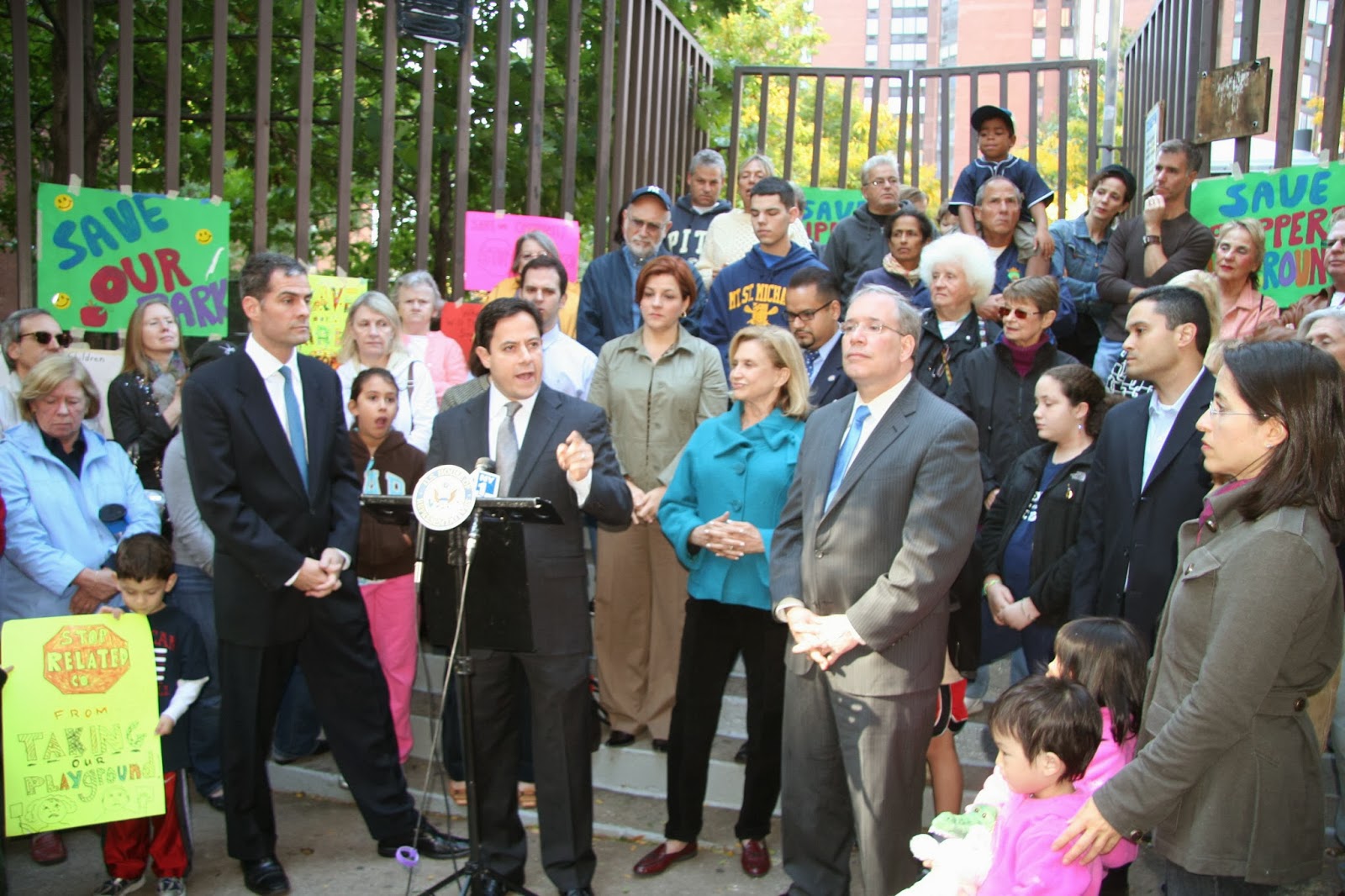
In February 2014, a coalition of area residents, environmental groups including NYC Park Advocates, business and home owners, and State Senator Tony Avella filed a lawsuit in New York County Supreme Court demanding the City halt its illegal handing over of mapped Parkland to build a mega-mall.
“Today’s decision sends a message loud and clear – our parks are not for sale," State Senator Tony Avella said in a statement.
"The fact of the matter is, this land was intended to be parkland, not the development of a shopping mall. In a city where public land is in short supply, simply handing parkland over is a betrayal of the public trust. The court has affirmed what we have been fighting for all along, and I am thrilled to see this decision come down on the side of justice,” the Senator said.
"I am very pleased that the Appellate Division, in blocking the development of a shopping mall on parkland next to Citifield, has upheld the ancient common law doctrine that requires any government agency to obtain the approval of the State Legislature before disposing of parkland," the plaintiff's lawyer John R. Low-Beer said in a statement.
"This extra layer of protection for parkland has evolved in recognition of the fact that parkland is a scarce and precious resource. It makes it a little bit more difficult for our government to give such land away. It makes sure that we think twice before doing so, no matter how worthy or expedient the proposed project may be."

The proposed mall on parkland was never part of the original Willets Point development that was approved in 2008. The most telling and disturbing comments relating to lack of accountably and desire to protect the 48 acres of public parkland however came shortly after the October 10, 2013 vote. Council member Julissa Ferreras attempted to justify and explain why the public parkland was now part of the deal and was given away - the developers and the Mayor wanted it. "The mall is something that the developers and the administration believe is necessary to be able to support the build-out of Willets Point," she said. (Photos: Geoffrey Croft/NYC Park Advocates)
Decision Below
Matter of Avella v City of New York
2015 NY Slip Op 05790
Decided on July 2, 2015
Appellate Division, First Department
Mazzarelli, J.p., J.
Published by New York State Law Reporting Bureau pursuant to Judiciary Law § 431.
This opinion is uncorrected and subject to revision before publication in the Official Reports.
Decided on July 2, 2015
SUPREME COURT, APPELLATE DIVISION First Judicial Department
Angela M. Mazzarelli,J.P.
Dianne T. Renwick
Sallie Manzanet-Daniels
Darcel D. Clark, JJ.
100161/14 15026
[*1]In re Senator Tony Avella, et al., Petitioners/Plaintiffs-Appellants, The City of New York, et al., Respondents/Defendants-Respondents.
Petitioners/plaintiffs appeal from the judgment of the Supreme Court, New York County (Manuel J. Mendez, J.), entered August 21, 2014, denying the petition for declaratory and injunctive relief in connection with the construction of Willets West, a retail entertainment center, in Flushing Meadows-Corona Park, and dismissing this hybrid CPLR article 78 and declaratory judgment proceeding.
John R. Low-Beer, Brooklyn, and Law Office of Lorna B. Goodman, New York (Lorna B. Goodman of counsel), for appellants.
Zachary W. Carter, Corporation Counsel, New York (Michael J. Pastor and Richard Dearing of counsel), for municipal respondents.
Skadden, Arps, Slate, Meagher & Flom LLP, New York (Jonathan L. Frank and Judith S. Kaye of counsel), for Queens Development Group, LLC and Queens Ballpark Company, L.L.C., respondents.
Fox Rothschild LLP, New York (Karen Binder and Jesse Masyr of counsel), for Related Willets, LLC and Sterling Willets LLC, respondents.
MAZZARELLI, J.P.
In 1961 legislation related to a stadium that was anticipated to be constructed in Flushing Meadow Park in Queens (the Park) was enacted. It was entitled "Renting of stadium in Flushing Meadow park; exemption from down payment requirements," and codified in Administrative Code of the City of New York § 18-118. The stadium that the legislation anticipated being constructed by the City in the Park was indeed built, and opened as Shea Stadium, the home of the New York Mets. In 2006, the owners of the Mets and the City agreed that the stadium would be demolished and replaced with a new stadium immediately to the east. That stadium, Citi Field, opened in 2009. The area where Shea Stadium once stood, and where Citi Field now stands, is bordered on its west by Willets Point. Willets Point is a 61-acre area that has long been considered by the City to be blighted. Indeed, Willets Point has no sewers, sidewalks or streetlights, is replete with potholed and rutted streets, and is prone to flooding. In 2008, the New York City Economic Development Corporation (EDC) embarked on its most recent attempt to develop Willets Point. It developed a plan that envisioned a mixed-use community including thousands of residential dwellings, 1.7 million square feet of retail space, 500,000 square feet of office space, 400,000 square feet of convention center space, 700 hotel rooms, 150,000 square feet of community facility space, a school, thousands of parking spaces, and at least eight acres of publicly accessible open space. In addition, the plan contemplated raising the level of Willets Point to address recurrent flooding conditions, remediating environmental conditions caused by decades of contamination and adding new streets along with sanitary and storm-water improvements. In connection with the plan, in November 2008 the City Council approved a number of zoning and mapping actions pursuant to the City's Uniform Land Use Review Procedure (ULURP), which established a "Special Willets Point District."
While the City initially sought to develop the entirety of Willets Point in one phase, this turned out to not be feasible because the size of the project and the state of the economy would prevent any interested developer from securing the necessary financing. Instead, the City determined, implementation of the development plan would have to be done in phases, and in May 2011 EDC issued a Request for Proposals to private entities for a modified development plan. In May 2012, EDC accepted a development plan submitted by the "Queens Development Group" (QDG), a joint venture between entities controlled by Sterling Equities Associates, the owner of the Mets, and The Related Companies, a real estate development firm. QDG proposed a two-phase project. Phase 1A, which was set to commence in 2015, would involve the construction of "Willets West," a retail mall and movie theater, on 30.7 acres of an existing parking lot adjacent to Citi Field, located outside the Willets Point Special District. Like the stadium, Willets West would be situated inside the Park. Phase 1A would also see the remediation of 23 acres of Willets Point, including installation of sewage systems, roads and ramps to access local highways, parking spaces, and the development of a 200-room hotel. Phase 1B, expected to commence in 2026, would involve the construction of mixed-income housing, a public school, and additional acres of open space. However, under the agreement between EDC and the joint venturers, the developers could avoid having to build Phase 1B by paying $35 million in liquidated damages.
In 2013, QDG and EDC jointly applied to the City Planning Commission (CPC), and submitted ULURP applications for a demapping of streets in Willets Point, a number of special permits, and a revision of the Special Willets Point District zoning. This was to allow "transitional" uses of the area, specifically interim parking lots and space for "active recreation." The ULURP applications were reviewed by two local community boards, with one recommending approval and the other recommending disapproval. The Queens Borough President approved the application with certain conditions. CPC then conducted its review and [*2]held a public hearing. After receiving a final environmental impact statement, CPC approved the application. None of these approvals directly pertained to the Willets West property, and during the approval process, CPC stated that questions concerning the development of Willets West on mapped parkland were not subject to the commission's land use jurisdiction and were beyond the scope of the application. The development plan subsequently was approved by the Zoning and Franchises Subcommittee of the City Council, the Land Use Committee, the City Council and the Mayor.
Petitioners, who are a State Senator, not-for-profit organizations, taxpayers, businesses, users of the Park, and other affected persons, brought this proceeding to enjoin the development of Willets West. In addition to injunctive relief, petitioners sought declarations that the City Council's approval of resolutions to facilitate construction of Willets West was arbitrary and capricious, that construction of the proposed shopping mall on unzoned property would violate section 11-13 of the New York City Zoning Resolution, and that the failure to apply for zoning changes or submit a new lease for Willets West through ULURP (New York City Charter § 197-c and § 197-d) was improper. As their central claim, petitioners sought a declaration that the parking lot on which Willets West would be built, which is the site that previously housed Shea Stadium, remains subject to the public trust doctrine, because it remains mapped parkland. They contend that Administrative Code § 18-118 does not provide authorization for the project, as the legislation "was only for the stadium itself and ancillary public purposes for the benefit of the people of the City, not for a gigantic commercial development profiting private real estate developers and retailers."
Respondents sought dismissal of the petition, arguing that the City's leasing of the parking area in Willets West that is designated parkland does not violate the public trust doctrine. They interpret Administrative Code § 18-118 as authorization by the State to alienate the area where Citi Field now stands for any listed public purposes, including those to be promoted by the development of Willets West, such as amusement, entertainment and the improvement of trade and commerce. Respondents further argued that since the parkland where Willets West is being developed remains under the control of the Commission of Parks and Recreation, there is no need for a zoning amendment designating a zoning district pursuant to Zoning Resolution § 11-13. They assert that since the lease for the mall is expressly authorized by statute, the statute overrides any other local law and the project thus does not require approval through the ULURP process. Finally, respondents argued that the challenged determinations approving the zoning actions were not arbitrary or capricious.
The court dismissed the proceeding. Its analysis of Administrative Code § 18-118 concluded that, rather than authorizing use of the property for a stadium alone, "the legislature took into consideration alternate uses of the property" and permitted approval of leases "for other uses to benefit the public." It further found that the legislative history of the 1961 statute establishes that "although the state legislature's initial intent for the parkland was Shea Stadium, other uses were acceptable" for public purposes for the benefit of the people of the City, including "improvement of trade or commerce." Finding that § 18-118 "applies to the use of the property for a shopping mall (that includes public programming space and a movie theater) will serve the public purpose of improving trade or commerce" and "will also serve the public purpose of ultimately altering the blighted Willets Point into a mixed use community," the court held that the public trust doctrine was not violated. The court also noted that "improvement of trade or commerce resulting from leasing the parkland including use as a shopping mall, is part of the development plan for purposes of creating an entire special district' and community which ultimately will result in the public benefit of removal of urban blight from Willets Point," and that the City has already undertaken substantial efforts in obtaining possession of property and relocating business in Willets Point.
Having found that Administrative Code § 18-118 applies to the development of Willets West, the court concluded that this legislative authorization removes the need to apply ULURP and Zoning Resolution § 11-13, noting that they do not apply where there is state legislation governing a specific land use. Accordingly, the court found that "there is no need to address Petitioners' arguments concerning the requirements of ULURP and [] Zoning Resolution § 11-13." The court nevertheless concluded that ULURP does not apply to the development plans and review of the business terms for the disposition of the parkland formerly used for Shea Stadium, as these powers have devolved to the Mayor, who has approved the development plan. Finally, the court found that the City's challenged determinations have a rational basis and are not arbitrary and capricious.
This dispute turns on whether the plain language of Administrative Code § 18-118 compels a narrow use of the parkland in question such that any additional construction on it must be directly related to a stadium, or whether any such construction on the parkland must only be related to one of the purposes delineated in § 18-118(b). The proper interpretation of the statute is critical in this case, because, under the public trust doctrine, dedicated park areas in New York are impressed with a public trust for the benefit of the people of the State, and their "use for other than park purposes, either for a period of years or permanently, requires the direct and specific approval of the State Legislature, plainly conferred" (Friends of Van Cortlandt Park v City of New York, 95 NY2d 623, 632 [2001] [internal quotation marks omitted]). Stated differently, parkland may be alienated or leased for non-park purposes as long as authorized by the legislature (see Miller v City of New York, 15 NY2d 34 [1964]), and the "legislative authority required to enable a municipality to sell its public parks must be plain" (Aldrich v City of New York, 208 Misc 930, 939 [Sup Ct, Queens County 1955], affd 2 AD2d 760 [2d Dept 1956]).
We thus turn to the language of Administrative Code § 18-118. It provides, in pertinent part, as follows:
"a. Notwithstanding any other provision of law, general, special or local, the city, acting by the commissioner, with the approval of the board of estimate, is hereby authorized and empowered from time to time to enter into contracts, leases or rental agreements with, or grant licenses, permits, concessions or other authorizations to, any person or persons, upon such terms and conditions, for such consideration, and for such term of duration as may be agreed upon by the city and such person or persons, whereby such person or persons are granted the right, for any purpose or purposes referred to in subdivision b of this section, to use, occupy or carry on activities in, the whole or any part of a stadium, with appurtenant grounds, parking areas and other facilities, to be constructed by the city on certain tracts of land described in subdivision c of this section . . ."
Section (b) of the statute, in turn, provides that
"b. Any contract, lease, rental agreement, license, permit, concession or other authorization referred to in subdivision a of this section may grant to the person or persons contracting with the city thereunder, the right to use, occupy or carry on activities in, the whole or any part of such stadium, grounds, parking areas and other facilities,
"(1) for any purpose or purposes which is of such a nature as to furnish to, or foster or promote among, or provide for the benefit of, the people of the city, recreation, entertainment, amusement, education, enlightenment, cultural development or betterment, and improvement of trade and commerce, including professional, amateur and scholastic sports and athletic events, theatrical, musical or other entertainment presentations, and meetings, assemblages, conventions and exhibitions for any purpose, including meetings, assemblages, conventions and exhibitions held [*3]for business or trade purposes, and other events of civic, community and general public interest, and/or
"(2) for any business or commercial purpose which aids in the financing of the construction and operation of such stadium, grounds, parking areas and facilities, and any additions, alterations or improvements thereto, or to the equipment thereof, and which does not interfere with the accomplishment of the purposes referred to in paragraph one of this subdivision. It is hereby declared that all of the purposes referred to in this subdivision are for the benefit of the people of the city and for the improvement of their health, welfare, recreation and prosperity, for the promotion of competitive sports for youth and the prevention of juvenile delinquency, and for the improvement of trade and commerce, and are hereby declared to be public purposes."
Respondents interpret the words "right ... to use, occupy or carry on activities in, the whole or any part of a stadium, with appurtenant grounds, parking areas and other facilities" in § 18-118(a) as authorizing the use of any part of the stadium, any part of the grounds, any part of the parking areas, or any part of any other facilities constructed on the site, so long as any such use is for one of the delineated purposes. They assert that because Willets West would "use" the parking areas, and because a shopping mall would satisfy § 18-118(b) by "improv[ing] . . . trade and commerce" for "the people of the city," it is authorized by the statute.
Petitioners counter that the term "use" is not broad enough to embrace a construction project of the type proposed by respondents. They argue that the language employed makes clear that, in enacting § 18-118, the legislature, contemplating the construction of a stadium in the Park, intended to provide only for how the stadium itself, and any necessary supporting facilities, such as parking lots, could be used. According to their contentions, the statute is concerned with trade and commerce that is conducted specifically with reference to the stadium. Therefore, they assert, it does not matter that the Willets West project is an improvement of trade and commerce, even one crucial to the reclamation of Willets Point.
In determining which party's construction of the statute is correct, we must adhere to the traditional rules of statutory construction. The primary rule is that "courts are obliged to interpret a statute to effectuate the intent of the Legislature, and when the statutory language is clear and unambiguous, it should be construed so as to give effect to the plain meaning of the words used" (People v Finnegan, 85 NY2d 53, 58 [1995], cert denied 516 US 919 [1995] [internal quotation marks and brackets omitted]). Further, "[i]t is an accepted rule that all parts of a statute are intended to be given effect and that a statutory construction which renders one part meaningless should be avoided" (Rocovich v Consolidated Edison Co., 78 NY2d 509, 515 [1991]). Finally, we must be mindful of "the statutory context of the provision" (New York State Psychiatric Assn., Inc. v New York State Dept. of Health, 19 NY3d 17, 24 [2012] [internal quotation marks omitted]).
We find that the overriding context of Administrative Code § 18-118 concerns the stadium to be built in the portion of the Park delineated therein. Interpreting the language plainly, the statute, boiled down to its simplest form, authorizes the City to permit "persons" to avail themselves of the stadium which the City plans to construct. Its focus is on the stadium, and the stadium only. There is simply no basis to interpret the statute as authorizing the construction of another structure that has no natural connection to a stadium.
This interpretation is confirmed by the use limitations laid out in subdivision (b). To be sure, the general purposes laid out in § 18-118(b)(1), considered in a vacuum, are not necessarily related to a stadium. Indeed, if one stopped reading after the words "improvement of trade and commerce," one might be led to believe that the uses contemplated by the legislature were without limitation. However, the general purposes are followed by specific examples, to wit: [*4]"professional, amateur and scholastic sports and athletic events, theatrical, musical or other entertainment presentations, and meetings, assemblages, conventions and exhibitions for any purpose, including meetings, assemblages, conventions and exhibitions held for business or trade purposes, and other events of civic, community and general public interest." Each of these examples is traditionally associated with a stadium. Obviously, Shea Stadium was used by the Mets for many years, and was also used to stage other professional and non-professional sporting competitions. Similarly, we know that Shea Stadium was used for musical presentations, such as the famous performance there by the Beatles. No actual examples of "meetings, assemblages, conventions and exhibitions" come to mind that took place at Shea Stadium, but one could envision such events being suitable for a large stadium. Indeed, Yankee Stadium has been known to host religious services. One could also imagine a large trade show, such as a car or boat exhibition, being staged at a stadium.
The fact that the examples given by the legislature as types of uses that improve trade and commerce all naturally relate to uses of a large stadium is significant to our analysis. That is because the canon of statutory construction known as ejusdem generis "requires the court to limit general language of a statute by specific phrases which have preceded [FN1] the general language" (McKinney's Cons Laws of NY, Book 1, Statutes § 239). Stated differently, the general phrase becomes "known by the company it keeps" (People v Illardo, 48 NY2d 408, 416 [1979]). Here, the purposes for which the "stadium, grounds, parking areasand other facilities" may be used are unquestionably wide, but only to the degree that they fit within the specific examples provided by the limiting language. To look past the specific examples, as respondents urge, would be to purposely ignore the clear intent of the legislature to curtail the use of this portion of the Park to a stadium. Accordingly, we are not permitted to construe the statute as authorizing uses merely related to the improvement of trade and commerce. We must interpret it as requiring any proposed use to be associated with the stadium and the necessary and natural appurtenances to it.
Section 18-118(b)(2) is also not supportive of respondents' position, because its use authorization is even narrower than subdivision (b)(1). Any use of the Park permitted by that subsection must be related to the financing of the construction and improvement of the stadium, and, according to the section, must "not interfere with the accomplishment of the purposes referred to in" subdivision (b)(1). Accordingly, pursuant to our construction of the statute, the uses described in subdivision (b)(1) must still relate to the stadium itself and the naturally expected uses of a stadium as listed in subdivision (b)(1).
We take no issue with the notion that Willets West is a potential driver of trade and commerce, and that it is a worthy first step in the City's long-stated desire to breathe new life into a neighborhood that is in dire need of improvement. However, the public trust doctrine is clear that any alienation of parkland must be explicitly authorized by the legislature. No reasonable reading of Administrative Code section 18-118 allows for the conclusion that the legislature in 1961 contemplated, much less gave permission for, a shopping mall, unrelated to the anticipated stadium, to be constructed in the Park. Further, it is simply not in our power to set the doctrine aside, no matter how worthy a proposed use of parkland may be. Here, while there is a legislative mandate for the use of the Park, that mandate does not encompass the use proposed by respondents. Thus, the Willets West project must be enjoined.
Accordingly, the judgment of the Supreme Court, New York County (Manuel J. Mendez, J.), entered August 21, 2014, denying the petition for declaratory and injunctive relief in [*5]connection with the construction of Willets West, a retail entertainment center, in Flushing Meadows-Corona Park, and dismissing this hybrid CPLR article 78 and declaratory judgment proceeding, should be reversed, on the law, without costs, and the petition granted to the extent of declaring that construction of Willets West on City parkland without the authorization of the state legislature violates the public trust doctrine, and enjoining any further steps toward its construction.
All concur.
Judgment, Supreme Court, New York County (Manuel J. Mendez, J.), entered August 21, 2014, reversed, on the law, without costs, and the petition granted to the extent of declaring that construction of Willets West on City parkland without the authorization of the state legislature violates the public trust doctrine, and enjoining any further steps toward its construction.
Opinion by Mazzarelli, J.P. All concur.
Mazzarelli, J.P., Renwick, Manzanet-Daniels, Clark, JJ.
THIS CONSTITUTES THE DECISION AND ORDER OF THE SUPREME COURT, APPELLATE DIVISION, FIRST DEPARTMENT.
ENTERED: JULY 2, 2015
CLERK
Footnotes
Footnote 1: Here the limiting terminology follows the general, but that distinction is immaterial.