Sunday, November 10, 2013

Prospect Park Alliance In Lakeside Skate Rink $ Windfall


A rendering of the two rinks at Lakeside,  part of a 26 acre $74 million redevelopment project in Prospect Park. The project,  along the southeast shore of the park’s lake,  has been troubled by delays and money issues.   Approximatly two-thirds of the budget came from city and state funds. The new facility replaces the Kate Wollman Memorial Rink which opened in 1961.


The financial windfall predicted for the Prospect Park Alliance is coming to fruition. Under a new deal the Prospect Park Alliance will run the complex under  a licence agreement with the city.   The Alliance will be required to pay the City of New York nothing for the first year and just $ 100, 000 annually beginning the second year according to the terms of the sole source concession agreement the city "negotiated"  with the influential group.  The Parks Department is now trying to claim the Alliance will receive the same amount of revenue from the Lakeside facility as they did with Wollman Rink in the early years - whatever that means. 

Parks sources have identified a December 21st opening date.  The rink will be open for limited hours during the week  Monday - Thursday - in order to maximixe revenue and reduce costs.   The deal goes before the mayoral controlled Franchise and Concession Review Committee on Tuesday,  November 12th.  

Brooklyn

By Geoffrey Croft


Call it a parting gift from the Mayor.  The Bloomberg Administration is getting ready to award a sweet-heart sole source deal to the Prospect Park Alliance to run the $74 million Lakeside Center project.

The Alliance will be required to pay the City of New York nothing for the first year and just $ 100,  000 beginning the second year of  a  seventeen year deal  according to the license agreement obtained by NYC Park Advocates.   

The annual fee to the city increases by  just a thousand dollars a year over the life of  the deal  culminating with $ 116,  097 in the year 2030.


The lucrative license agreement -  potentially worth tens of millions of dollars over the life of the agreement - seeks to reward the public/private partnership handsomely for raising $ 19 million of the Lakeside Center's $ 74 million dollar budget, while also 

requiring  the group to continue to raise private money for the general operation of the public park which they have done for years.

Approval for years 3 through 17 are continent upon the Alliance renewing it's maintenance & operation agreement for the park which expires in July 2015. 


The indoor rink's newly installed dasher boards under the dark blue painted ceiling, "incised with a constellation of big silvery curlicues, like giant skate marks," -  frame the dance floor and cocktail area for The Prospect Park Alliance's Lakeside Ball gala held on Saturday night.  Tickets for the event began at $ 425 and went up to $ 50,000 for a table of ten. (Photos: Geoffrey Croft/NYC Park Advocates) Click in images to enlarge


The city "negotiated" the sole source concession agreement with Prospect Park Alliance to operate and maintain the Prospect Park Lakeside Center including two skate rinks (one covered and one open) during the winter, a roller rink during the summer, a cafĂ© with three adjacent private event rooms, boat rentals and  bicycle rentals. 

The agreement also allows the group to operate mobile push carts in the park near the facility. 


The City has also forgone the standard  "vs. a percentage of gross receipts, whichever is higher" language  found in Parks Department revenue licensing contracts. 


The flat rate locks in a low return to the city regardless of revenue generated from the facility. 


The City is also paying all utility costs - electricity,  water,  gas,  heat and sewer costs and coolant associated with the operation of the 26, 000 sq. ft. ice center.  (Operators of the Cafe however will be responsible for electrical and gas costs.)  

In other unusual provision in the agreement, if gross receipts exceed seven million dollars annually the City and the Alliance,
"to confer in good faith,"  agree to discuss whether or not the Alliance should pay for utility costs. 

The Alliance is expected to make out handsomely in the new deal  as revenue at Lakeside are expected to dwarf the former Wollman Rink's deteriorated single rink ice facility earnings. 

The city received more than 45 percent of the rink revenue during Wollman's last year of operation.   In 2010,  Wollman generated $512, 000 in revenues with $232, 000 from entrance fees heading back to the city’s general fund and the remaining $280, 000 from other concessions going to the Alliance for park maintenance. Under the new plan,  the Alliance would collect all the revenues and give the city back a small flat and keep the rest ostensibly  towards maintaining the park.

The Prospect Park Alliance refused to respond to several requests seeking comment including providing Lakeside revenue projections.

By comparison in Central Park Donald Trump operates two popular ice rinks that raised $6.6 million in revenues in 2011. The city got back $2.2 million for its general fund,  which pays the expenses for city services.


The rink will be open limited hours during the week  Monday - Thursday - just twenty hours - in order to maximize revenue and reduce costs.    The rinks will be open for 26 hours on the weekends. 

The project has been plagued by cost overruns, delays and a loss of funding. 

The facility is expected to open a few days before Christmas. Parks sources have identified a December 21st opening  date. 

The deal goes before the mayoral controlled Franchise and Concession Review Committee on Tuesday,  November 12th.

Bloomberg family friend Elizabeth "Betsy" Smith - head of revenue and marketing for the Parks Department will sign the deal for the City,  along with Prospect Park Alliance head, Emily Lloyd.  

The Parks Department also refused to reveal projected revenue for the Alliance and instead dumped a statement meant to deceive and without providing any information.   

"After paying the fee to the City per the concession agreement, we expect the Prospect Park Alliance will receive the same amount of revenue from the Lakeside facility as they did with Wollman Rink in the early years. All revenue generated from Lakeside and the operator will be used to support park programming and maintenance," the agency said.

Each year  the City's elected officials allocate a fraction of the funds desperately needed to properly maintain, operate, secure, and program our  public parks.

The city continues to try and abdicate its responsibilities by entering in these so called public/private agreements that officials are not only allowing but actively encouraging.  They are increasingly resorting to these pay-to-play funding schemes.   

These deals hand over enormous power and decision making authority to these groups with little transparency and accountability on what is supposed to be public land.

Influential park groups are increasing relying on revenues generated from parkland being diverted from the City's general fund into their coffers. 


Abraham Lincoln admiring the new view. The $ 74 Million dollars includes the restoration of the long-neglected shoreline, esplanade and Concert Grove. New walking and jogging paths, picnic areas, lawns and a boat dock. It also recreates Music Island, now as a nature preserve, with bald cypress, duck potato and other native trees and plants.

Abraham Lincoln holds the Emancipation Proclamation in Henry Kirke Brown's beloved statue.  Mr. Lincoln points to the words “shall be forever free.”    In 1895 the sculpture was moved from its original location - in the elliptical plaza adjoining Prospect Park, today known as Grand Army Plaza - to its current location.  For the last 50 years, the statue had faced a chain-link fence near the old Wollman Rink.


Recent financial decisions by the Prospect Park Alliance involving the privatizing of public land park for commercial uses have come under intense public scrutiny. The Alliance made peanuts from the controversial GoogaMooga booze event which destroyed parkland for two consecutive years and prevented the public being able to access dozens of acres of parkland for months. The City recently caved in and decided not to allow the event to return to the park after two years of public outcry.

The City's decision to allow the Alliance to privatize the beloved Boathouse  - the Audubon Center education center on weekends has also outraged local residents.  The group pocketed $ 200,000 in just a few months this year from renting out the historic building which prohibits public access. 

Tickets  for the Prospect Park Alliance Ball,  the non-profit's high-priced gala held on Saturday night,  began at $ 425 and went up to  
$ 50,000 for a table of ten.


Other Details include:


Ice Rink Admissions prices for are set for  $ 6.00 on weekdays, $ 8.00 on weekends and holidays, and ice skate rental is $ 5.00 at all times. 


Beginning next year the rink will be required to be open no later than November 30th.

Minimum Public Hours of Operation - Ice Skaking

Friday - 3pm to - 9pm
Saturday - 10am- 10pm
Sunday - 10am - 6pm


Addtionally another 20 hours per week shall be provided Monday - Thursday on one and or/other of the two rinks. 


The  $ 54 million dollar project also includes  the restoration of 26 acres of the Prospect Park Lake area area including its shoreline, adding five acres to the Lake and three acres of green space in the area. 


The Waterplay feature will be open from Memorial Day though Labor Day daily from 10am, to sunset.


The 54 page License agreement also contains three pages of Vending Machines Standards

Read More:


A Walk In The Park - May 18, 2012


New York Post - November 10, 2013 - By Rich Calder

New York Daily News - November 10,  2013 -    By Reuven Blau


Monday, November 4, 2013

Little Italy Residents Fights To Save Elizabeth St. Garden From Development


Little Italy fights to save Elizabeth St. Garden from affordable housing
The Elizabeth St. Garden between Prince and Spring Streets.  Long used exclusively by the adjacent Elizabeth Street Gallery who rents it from the city, the public finally began having access to it over the Summer.  A campaign has been launched to save it from development.   The lot development plan was tacked onto discussions as part of the the city’s Department of Housing Preservation and Development  as part of the $1.1 billion Seward Park Urban Renewal project at the foot of the Williamsburg Bridge, a mixed-use complex to include 1,000 housing units with 500 for low- and middle-income tenants.  (Photo: Helayne Seidman) 

The issue is on the agenda at Community Board's 2 meeting on November 4th at 6:30 p.m. at P.S. 130 Hernando De Soto School Auditorium 143 Baxter Street (Between Hester & Grand)

Manhattan

Little Italy residents are fighting to save a rare oasis of grass, flowers, trees, ornate benches and statues slated to be bulldozed for housing, according to the New York Post.
The Elizabeth Street Garden, a 20,000-square-foot city-owned lot, was tapped for affordable housing in a push by Councilwoman Margaret Chin. But residents say the deal went “under the radar” and caught them by surprise. Community Board 2 has called its first hearing on the project for Monday and residents have launched a “Save the Garden” petition.
“We need affordable housing, but this is already a beautiful garden. Let’s make it a park,” said Jeannine Kiely, a resident and mother of two. Little Italy and Soho have .07 acres of parkland per 1,000 residents — one of the lowest ratios citywide, she added.
Neighbors learned only last summer that the garden — leased for $4,000 a month to the adjacent Elizabeth Street Gallery — is city land and asked gallery owner Allan Reiver to open it to the public. A first-ever Harvest Fest last month drew 1,500 for pumpkin painting, the planting of 2,000 daffodils, food donated by local eateries and a live band. Since summer, the Elizabeth Street Garden has been a popular space. Workers use the spot to eat lunch, parents take kids to do homework, and other residents relax or tend to the planting beds.
“It was really a coming together of all types of people, and showed us what this garden could be for the community,” said Emily Hellstrom, a mom of three.
But city officials say Reiver is violating his month-to-month lease, which specifies the lot can be used for “storage” only.
The lot development plan was tacked onto discussions for the $1.1 billion Seward Park Urban Renewal project at the foot of the Williamsburg Bridge, a mixed-use complex to include 1,000 housing units with 500 for low- and middle-income tenants.
The city’s Department of Housing Preservation and Development will create a separate plan for the Elizabeth Garden lot and could not say what mix of affordable and market-rate units it may bring, a spokesman said.
Elizabeth-Street-Garden-Harvest-Fest-2013-2
Participants attend the Elizabeth Street Garden Harvest Festival on October 20th.
Read More:
New York Post - November 3, 2013 -  By Susan Edelman 

Sunday, November 3, 2013

Willets Point Lessons: Trading Parkland for Developer's Donation


Sorry, image not available
Delivering The Deal.  A beaming Related Companies' Charles  J.  O'Byrne, Queens City Council member Julissa Ferreras,  Jeff Wilpon - New York Mets COO and the executive vice-president of Sterling Equities and son of New York Mets principal owner Fred Wilpon, and Glenn  A. Goldstein - president of Related Retail and registered lobbyist, pose on October 10, 2013 shortly after a City Council vote. (Photo: William Alatriste /New York City Council via A Walk In The Park)

In the second of part of a series on a development process that spanned much of the Bloomberg administration, City Limits looks at how parks fare under this deal—and others.

City-Wide

Immediately after the City Council approved the redevelopment of Willets Point early this month, Queens Councilwoman Julissa Ferreras posed at the front of the chambers for a celebratory photograph with the developers. She had brokered the final deal only hours before in the Bloomberg administration's offices at City Hall—and inadvertently paved the way to a troubling future for New York City parks, according to an article in City Limits. 
Private money for a neglected park was at the center of Ferreras' deal with the Willets Point developers, who would be drawing on free land and taxpayer subsidies worth more than the entire annual budget of the city's Parks Department.

The developers—Related Companies and Sterling Equities, the real estate firm of Mets' owners Fred Wilpon and Saul Katz—agreed to contribute $15.5 million over 25 years to the Flushing Meadows Corona Park Alliance, a nonprofit Ferreras had just founded with the Parks Department and the group New Yorkers for Parks.
The Willets Point plan involves the building of a 1.4 million-square-foot shopping mall and multi-story parking garages on 46 acres of mapped parkland at the northern end of Flushing Meadows. Even as the proposed mall encountered neighborhood opposition—Community Board 3 voted 30-1 to reject the plan—Ferreras was actively soliciting funds from the developers.
"They know I expect them to contribute," she told City Limits this summer, pointing out that the Mets' stadium was already located in the park. If the team's owners wanted to build their mall there too, she said, they would have to give money to her nonprofit. "I am knocking on their door." Months earlier, Ferreras' park alliance had accepted $10 million over 23 years in exchange for her support of the U.S. Tennis Association's expansion in Flushing Meadows.
In many ways, the Flushing Meadows deals are emblematic of a larger predicament in city parks: For years, the government has inadequately funded parks, so private money has helped to pay for park upkeep.


Related Companies and Sterling Equities are looking to build a 1.4 million square foot mall on 48 acres of mapped parkland in Flushing Meadows-Corona Park, west of Citi-Field stadium.  This represents the largest public parkland giveaway in recent history. The proposed   Willets Point West Mall project would allow the seizing of the public parkland to be used exclusively for non-park purposes without first getting State Alienation approval as is required under the law.  The construction of such a mall on public parkland would be unprecedented. (Photos: Geoffrey Croft/NYC Park Advocates) 

That money usually gravitates to affluent neighborhoods, leaving parks in poorer areas behind. This time, in Flushing Meadows, a park in a lower-income area is getting in on the action, but on different terms: Parkland is effectively being traded to a private company for money to maintain the park that's left.
Our grass, their greenbacks
The amount of private money now paying for New York City parks is staggering. Parks Commissioner Veronica White put the figure at $76 million a year during a recent City Council hearing, but documents obtained by City Limits via the Freedom of Information Law indicated that 26 private groups alone contributed an annual $162 million in 2011 for parks' maintenance and operations. If accurate, that's equal to more than half of the city's yearly tax-levy budget for parks. The Parks Department did not answer questions about these numbers.

*   *    *
Read the rest of this series:
Part 1:
Will a New Mayor Do Development Differently?
Part 3:
Relocation Fears for Workers

*   *    *

The city claims the private investment allows it to target limited taxpayer resources to the parks most in need, but critics say the use of private funding has encouraged a further winnowing of resources to the Parks Department and created growing disparitiesamongparks for the haves and have-nots .
While Manhattan and Brooklyn have ended up with some showplace parks, no one is interested in operating, say, Highland Park on the Brooklyn-Queens border or Ferry Point Park in the Bronx. Donald Trump has struck a deal to take about half of the 413-acre Ferry Point to build a private club and a "world-class" golf course on what had been a garbage dump , but he won't be sharing the revenue with the park, and it's unlikely the patrons of his luxury facility will be the residents of the neighboring public housing project.
Even middle-class and well-heeled areas have been forced to pick up the slack, with volunteers maintaining such parks as Juniper Valley Park in Middle Village, Queens, and Dag Hammarskjold Plaza in Manhattan, right across the street from the United Nations. Half of the city's 1,800 parks and playgrounds now depend on some type of private group to at least chip in on maintenance, according to the Parks Department, but many, if not most, of these groups struggle.
Some people, like Public Advocate and mayoral candidate Bill de Blasio, have pinned their hopes for more equitable parks funding on legislation proposed by state Senator Dan Squadron that would create a Neighborhood Parks Alliance to take 20 percent from the budgets of large park conservancies and distribute that money to the parks most in need. "It will make for a fairer city," says de Blasio, "and I think it's a great idea."
But the proposed alliance would be blocked from accessing a large part of the nonprofit funds, says James J. Fishman, a professor at Pace Law School. Endowments would be off-limits, and if donors make restricted gifts, then that money can't be diverted to another use. Nonprofit-law experts consulted by City Limits say the legislation is sure to face legal challenges.
Fact is, the proposed fund would draw from the same private-money system that led to the great disparities it seeks to correct, and the redistribution of money simply won't be enough to right the deeper wrongs. There is no such thing as a free lunch: Taxpayers still cover a portion of the budgets for even the biggest park conservancies, and that means they would end up funding the Neighborhood Park Alliance too. In the end, most public parks remain the responsibility of the public.
More land, less labor
While Bloomberg's borrowed $6 billion over the last 12 years to build new parks and improve existing ones, upkeep relies on the operating budget, and the mayor has consistently allocated 0.5 percent or less of the city's tax-levy budget to maintain parks, which account for 14 percent of the city's surface area.
In contrast, back in the days of Robert Moses, parks maintenance and operations routinely claimed about 1.5 percent of the operating budget. Even under Ed Koch, with the city barely out of the fiscal crisis, roughly 0.8 percent went to parks. Bloomberg has regularly proposed budgets with even smaller shares.
Last year, a Parks Department internal review appealed for the city to hire 682 more workers. In response, Bloomberg paid at least $675,000 for the consulting firm of Pricewaterhouse Coopers to evaluate how the department deploys its current workforce and resources to maintain parks. "The mayor wanted justification," explains one Parks Department employee who requested anonymity in this article. Imagine Bloomberg's surprise, then, when Pricewaterhouse Coopers found the Parks Department needed to hire even more workers than had been requested.
The reasons why are revealed in e-mails and a PowerPoint presentation, titled "Parks Operations for the 21st Century," based on the consultant's report, obtained under the Freedom of Information Law. The publicly financed documents were heavily redacted, but what remained visible among the blacked-out pages painted an ugly picture.
"Over the last five years," the consultants noted, maintenance and operations staff had "decreased by 13%," as the agency was "in full attrition," meaning it was not replacing workers who had left or retired. The mayor's management report showed a more precipitous drop from 2009 to 2012, with total personnel – including both full-time and full-time equivalent staff – falling by 24 percent. Some parks have always fared worse than others. Over the course of Bloomberg's 12 years in office, the full-time maintenance staff at Flushing Meadows Corona Park shrunk from 35 to 13.
Most parks depend on roving crews of workers, who spend much of their time in transit. The consultants found that 54 percent of all Parks Department work-order hours were logged by JTPs—or Job Training Participants, the temporary-employment program for people on public assistance—and 91 percent of JTP time was spent on simply "cleaning," or picking up litter. "JTPs are the majority of the workforce," Pricewaterhouse Coopers noted, "because their hourly [pay] rate is much lower."
With 61 percent of work orders more than 90 days overdue, the consultants discovered bleak conditions in neighborhood parks throughout the five boroughs. Photos and eyewitness accounts captured the details: Broken drinking fountains and cracked concrete foundations, "huge amounts of dead trees made into wood chips … lots of homeless people and trash buildup … algae problems," and illegal dumping.
The Pricewaterhouse report links maintenance deficiencies to safety hazards, zeroing in on the problem of falling tree limbs. That problem appears to have grown worse in recent years, despite attracting a lot of attention. Over an eight-week period this summer, the watchdog group NYC Park Advocates counted 13 incidents of falling limbs injuring parkgoers. Two lawsuits involving diseased trees in Central Park cost the city $14.5 millionthis year.
According to Pricewaterhouse Coopers, the average response time to a complaint like "the branch is cracked and will fall" is 20 days, ranging from 9 days in Queens to 48 days in the Bronx. These endemic delays were unsurprising as well, given that the Parks Department had 91 "pruner" and "climber" jobs to take care of the city's 2.6 million trees; following the Pricewaterhouse Coopers report, 30 more were taken on. After a pregnant woman was killed by a tree in Kissena Park in August, the city said it would hire another outside consultant to look at the problem.
Pricewaterhouse Coopers ultimately discovered the city needed to hire more workers. Last January, the Parks Department had 3,329 full-time workers, and the consultants advocated a bump up of 1,910. The agency added 1,165 seasonal temps and filled 150 open positions it previously couldn't fill. In March it announced the hiring of an additional 414 full-time employees, including nearly 100 with trade skills. When all job categories are combined, the new total falls 181 positions short of the Pricewaterhouse Coopers' recommendation, says the Parks Department. According to the mayor's management report for fiscal 2013, the number of full-time parks jobs was still below the level of just three years before.   
After crime rose in parks by 7 percent in 2012—and after the Pricewaterhouse Coopers report identified staffing deficiencies—the number of Parks Enforcement Patrol (PEP) officers was almost doubled this year to 167 officers, still a far cry from a high of 450 in the 1990s, according to Joe Puleo, president of Local 983 of the municipal-employee union DC 37, which represents city parks workers, including PEP officers.
He welcomes the additional hires, but thinks they are still far too few to patrol the city's 29,000 acres of parkland. "Everybody knows the Parks Department is massively understaffed, but Bloomberg had to spend all of this money to identify the obvious," he says, referring to the pricey Pricewaterhouse research.
Revenue leaves
Last year, Bloomberg put White, the former head of his Center for Economic Development, in charge of the Parks Department. At the announcement, he stressed the central role of public-private partnerships and corporate sponsorships in future park operations: "Otherwise we won't be able to afford all the things we're trying to do."
But at the same time Bloomberg was refusing to hire more workers, in 2009, parks were generating in excess of a record $110 million a year from concessions, lease agreements, recreation fees, and special-event rentals. All of this money went into the city's general fund, not into parks.
Meanwhile, the administration permitted some private entities to profit handsomely off parks. For ten months a year—from August to June—the city allows Lincoln Center to rent out the 2.4-acre Damrosch Park and to keep all of the revenue from it, estimated to be about $9 million annually, according to a recent lawsuit by residents near the park.
Over at the Madison Square Park Conservancy, founding board member Danny Meyer runs a multimillion-dollar business in the park. His Shake Shack pays a percentage of its revenue to the city and the conservancy, but that share is a fraction of what park concessionaires normally pay. Even with his sweetheart deal, Meyer picked up an additional $47,080 from the conservancy in 2011, according to the nonprofit's last available tax filing.
By law, all concession revenue is supposed to go to the city's general fund, but the Bloomberg administration has increasingly allowed select nonprofit park groups to take a cut. Back in 2006, the Central Park Conservancy renegotiated its contract to keep a greater percentage of its park's concession revenue, which has resulted in millions of extra dollars. The High Line effectively gets to keep all of its concession revenue, even from concessionaires on the street below the park.
Bloomberg continues to push for more commercial enterprises in parks. Back in 2004, the mayor responded with a shrug to protestors of another Meyer-related project—a plan to establish a high-end restaurant in Union Square Park, backed by a multimillion-dollar anonymous donation. Bloomberg asked, "How do you expect us to pay for parks?"
In Queens, fears of a precedent
Though Ferreras compared her new nonprofit to the Central Park Conservancy and the Prospect Park Alliance, she had created a new model, funded not by philanthropic contributions but by extracting money from businesses that want parkland.
When Ferreras told City Limits of her plans to ask the Willets Point developers for money, she listed other businesses located in the park, including the Mets and the Terrace on the Park banquet hall, noting that all of these businesses already operate under agreements with the city—the Terrace on the Park, for example, pays the city $2.5 million a year, or $100,000 more than the U.S.T.A.
But some park advocates fear Ferreras's forging of separate deals will now set a dangerous precedent, encouraging more development in underfunded parks. The Willets Point deal was "shameful," according to Richard Hellenbrecht, president of the Queens Civic Congress, an umbrella organization of 106 civic and community groups. The Congress opposed the mall plan not only for its taking of parkland but for the harm it could cause to local small businesses, not to mention the likelihood of more traffic and congestion.
"It's taking parkland, mapped parkland," Hillenbrecht says of the "Willets West" shopping mall. "It makes me angry. I worry about this in a lot of ways, and it upsets me that it could have been approved so quickly, ignoring all the concerns of Queens residents. We're going to have a new administration in a few more months. Why couldn't it wait?"
Several community groups have told City Limits they're contemplating a lawsuit over the city's claim that the shopping mall is permitted under a 1961 law that allowed for the financing of Shea Stadium. They claim the administration wants to avoid the burden of alienating that parkland, which would require state legislation to strip the land of its legal protections. Alienation legislation mandates the replacement of lost parkland or a payment for other park improvements equal to the land's fair market value.
As for the combined $25.5 million for Flushing Meadows from the mall and tennis projects, more than half of it will be spent on one-time capital improvements while the rest gets spread over two decades. That might sound like a lot of money, but it amounts to an annual $550,000 over most of the life of these two deals.
"That really won't do much," Hellenbrecht says. "It might pay for some more staffers, but not many. It's not enough to make a dent in what needs to be done, either operationally or even capital-wise. It's better than nothing, but I'd rather not have somebody taking parkland."
This article was reported in partnership with The Investigative Fund at The Nation Institute.

Read More:

Lessons of Willets Point: Trading Parkland for Developer's Donation
City Limits - November 1, 2013 - By Patrick Arden

Union Square: Man Declared Brain Dead After Being Discovered On Park Bench: 2nd Park Death In Two Months

View image on Twitter
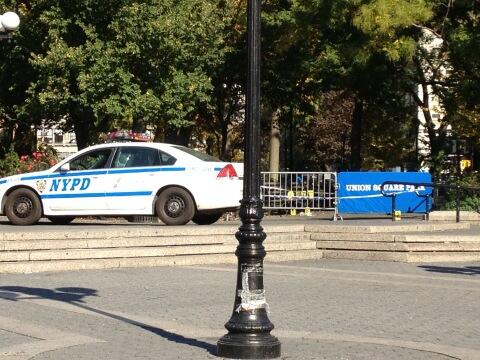
A 28-year-old Hispanic man was found  by police just before 12:30 am early Saturday morning in Union Square Park with head and face injuries.  The body was found on a park bench btw. 14/15th Street & Union Square East. The man was taken to Bellevue Hospital and has been declared brain dead police told A Walk In The Park.  (Photo: Joey Boots/via gothamist)

On September 4th  Sheepshead Bay resident Jeffrey Babbitt, 62, died after being assaulted in Union Square Park.  Martin Redrick, 40, was charged in the savage attack .

Manhattan


Police say a man who was found bloodied and bruised in Union Square Park last night is brain dead. A 28-year-old Hispanic man, who hasn't been identified yet, was found just after midnight in the vicinity of Union Square East and East 14th Street. Cops tell us that while officers were doing foot patrols of the park, they found the unresponsive man on a park bench, with injuries to his head and face, according to gothamist. 
He was taken to Bellevue Hospital in serious condition; his family has been contacted now that he is brain dead, and cops sectioned off the park this afternoon. One person wrote on Facebook, "Never seen the square actually empty."
Cops stressed that the medical examiner has yet to determine the cause of death, but there are two scenarios currently being looked at: the man's injuries may have been caused by an assault, or by a fall. The man's family indicated to police that he has underlying medical issues which could have caused a fall to happen, but nothing has been determined yet.
Joey Boots, who was at the park this afternoon, noted that there was a trail of blood leading up the handicap ramp on the east side of the park. 
Read More:

Man Brain Dead After Being Found Bloodied In Union Square
gothamist - November 2, 2013  

Man Declared Brain Dead After Being Discovered Injured In Union Square
WCBS - November 2, 2013

A Walk In The Park -  September 9, 2013 


Friday, November 1, 2013

Parents Plan To Sue City Over Broken Legs Suffered On Dangerous Park Slope Playground Swing

<p>The swing on the right was temporarily removed from Slope Park playground after at least three children fractured their ankles while playing on it.</p>

At least five Notices of Claims have been filed with the city over injuries sustained by young children on the green swing in Slope Park Playground located on 6th Avenue, between 18th & 19th Street.  Last week lawyers representing four families claimed in court papers that the swing was installed  "dangerously close to the ground." Attorneys are investigating who was responsible for installing the swing, and whether the manufacturer's instructions were followed.  The notice of claim also blames the Parks Department for failing to remove it after several children were injured.  (Photo: Leslie Albrecht /DNAinfo)

The swing was eventually removed after at least eight children were hurt - including those who suffered broken legs and ankles - within a few months after the newly renovated playground was opened in June.

Kelner & Kelner represents four of the children hurt. Robert Kelner, a personal injury lawyer represented the wife of slain Wall Street Journal reporter Daniel Pearl who was murdered in Pakistan.

Brooklyn


At least five families whose children wound up on crutches after playing on a South Slope swing plan to sue the city over the injuries, according to DNAinfo.
The parents of five kids who fractured their legs while playing on the swing at Slope Park on Sixth Avenue and 18th Street have filed notices of claim with the city and plan to file lawsuits, attorneys for the families said.
"This was an accident waiting to happen," said attorney Robert Kelner, whose firm Kelner & Kelner represents four of the children. One child required surgery after the injury.
Kelner said he knew of three other kids who fell victim to the equipment, but who aren't represented by him.
Photos of the swing show that it was too close to the ground, making it dangerously easy for little legs to get caught, Kelner contended.
"It is outrageous when one child is hurt on a device which is moronically set up, but when seven kids break their legs, and this all occurs in a short period of time in a New York City park where children are playing, it's frightening that no one from the city saw this device set up at this height and shut it down," Kelner said.
Kelner attorneys are investigating who was responsible for installing the swing, and whether the manufacturer's instructions were followed. In the notice of claim documents they've filed with the city, they point the finger at the Parks Department for positioning the swing "dangerously close to the ground" and failing to remove it after several children were injured.
The Parks Department did not respond immediately to a request for comment.
The family of another little girl who was hurt on the swing is also planning to sue, said her attorney, Mark Seitelman. His firm represents Erin Frazier, a P.S. 295 fourth-grader who fractured her leg on the same day as another child.
The swing was installed as part of a major renovation at Slope Park, and kids were eager to try out the new equipment when the park reopened after a lengthy closure in June 2013.
But just a week and a half later, one of Kelner's clients fractured her left leg on the swing. After several other kids suffered similar fates and parents called 311, the swing was removed in September.
A spokesman for the swing's manufacturer, Landscape Structures, Inc., said the equipment appeared to be incorrectly installed. Landscape Structures, based in Delano, Minn. has sold 300 such swings across the country. The one in Slope Park is the only one in the New York City area, a spokesman for LSI said.
There's been one other case of a reported injury on the swing, which is called the Oodle swing. In Boston in 2012, a child was injured on a swing that was improperly installed, the LSI spokesman said.
"The fact that there are so many fractures — it's proof that this was a disastrous setup," Kelner said.
Read More:
DNAinfo - November 1,  2013 - By Leslie Albrecht  

Kids Injured By Swing In Newly Opened Park Slope Playground
A Walk In The Park - September 12,  2013